

















If there is one phrase that seems to serve as a lodestar for Bell chief executive Lisa Atherton – she returns to it on several occasions, as if to hammer the point home – it is delivering on your promises.
“My emphasis is on accountability. If you talk to people that know me [they’ll say] my belief system is largely set around doing what you say you’re going to do, and when you make a commitment to someone, then make sure that you follow through on that,” she tells FlightGlobal.
“If you tell somebody, I’m going to get you that engineer drawing release done by Friday, get it done. If you tell your customer you’re going to deliver an aircraft on this day, get it done.”
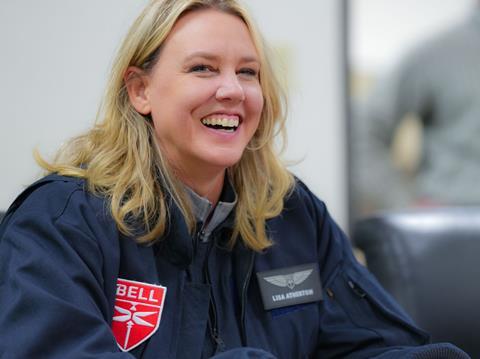
Atherton has been in the rotorcraft maker’s hot seat since April 2023, succeeding the retiring Mitch Snyder, and oversaw a year, 2024, which she believes has “changed the trajectory of Bell for decades to come”.
In essence, that comes back to Bell delivering on its promises: in August that year, the US Army judged the company’s Future Long Range Assault Aircraft (FLRAA), and its processes, sufficiently mature to approve the so-called Milestone B decision, marking the beginning of the programme of record for the new tiltrotor.
The US Army had selected Bell in December 2022 as the winner of the FLRAA contest, but achieving Milestone B was a significant point in the process, giving Bell the green light to begin building the first engineering and manufacturing development (EMD) assets for what has since been renamed the MV-75.
Proceeding with the MV-75 – the army’s long-term successor to the Sikorsky UH-60 Black Hawk – should be transformational for Bell’s defence business, if not for the entire company.
Prior to its selection, Bell appeared to be a fading power in military rotorcraft, with production of its three big US programmes – the AH-1Z, UH-1Y and the V-22 Osprey tiltrotor it builds with Boeing – all winding down.
But at a swoop, the deal put Bell at the heart of the US Army’s future aviation strategy, opening up the potential to offer the MV-75 to other branches of the US military and ultimately to the export market.
Atherton is far too modest and too respectful to claim credit for the win – after all, much of the foundation was laid by her predecessors – but hails the progress Bell has made since, aided by the army’s decision earlier this year to accelerate the programme.
“We have only been in the EMD phase for one year, and we are already making parts. We’re seeing tooling come together, engineering drawing releases are being put out at record pace – it’s improving each and every day with speed,” she says.
Bell is contracted to deliver six prototype aircraft, with the company projecting it will hand over the first example in 2026; flight testing by the customer is due to commence in 2027 or 2028, ahead of operational MV-75s reaching frontline units in 2030.
The fast pace of development has been aided by the digital design behind the MV-75 and close collaboration with the army, allowing changes to be rapidly encapsulated. Indeed, the co-operation with the service is also shaping tweaks to the cabin over Bell’s original V-280 technology demonstrator.
Atherton is wary of releasing too much detail on how the two platforms will differ but says feedback from “user touchpoint” testing – detailed evaluations of cabin mock-ups by the troops who will eventually fly in the MV-75 – “has been folded back into the design”.
“By and large, the specifications around speed, agility, range remain the same, but it is now about trying to refine the user touchpoints to make sure that the aircraft is optimised for the soldier.”
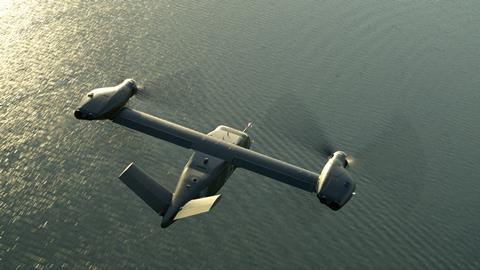
Bell was also recently selected by the US Defense Advanced Research Project Agency (DARPA) to build an X-plane demonstrator for its Speed and Runway Independent Technologies (SPRINT) effort.
This will see the airframer advance its “Stop/Fold” technology, with its concept resembling a traditional tiltrotor aircraft for vertical and initial horizontal flight, alongside an additional mode for high-speed jet-powered flight where the rotor blades fold towards the rear of the aircraft.
These programmes, and others, make it “a really a cool time to be a part of Bell”, says Atherton.
She argues the current period of rapid progress harks back to an earlier part of Bell’s 90-year history where it pioneered “amazing innovations – some wild rides”, such as jetpacks, breaking the sound barrier with the X-1, and early involvement in the space race.
Sadly, Bell then “got a little complacent” and despite a “really good product portfolio”, there was the sense of a company, that had become, well, a bit staid.
But over the last 10 or 15 years Bell has changed, Atherton says: “We had to tap into what we were known for.”
It has been about “really trying to anticipate what people need, versus waiting to be told”, she says, supported by digital engineering and modular open systems, and “really going places ahead of others in the industry. It is a really exciting place to work.”
Bell’s commitment to tiltrotor technology also extends to supporting European airframer Leonardo Helicopters on its push into the space.
Initially focused on concept design work for a NATO-led programme – the Next Generation Rotorcraft Capability project – the extent or nature of that collaboration remains unclear.
Atherton is reluctant to reveal much detail but says the “open-ended agreement” sees Bell leverage its 15-year experience of “moving forward with our sixth generation of tiltrotor expertise”.
Leonardo is also pursuing a civil tiltrotor, the AW609, with Bell playing a “support role” – a legacy of the programme’s origins as a joint venture.
“I am cheering them on with their certification efforts with the Federal Aviation Administration [FAA]. I do think that for them to achieve a civil tiltrotor certification would be of great benefit to the industry,” adds Atherton.
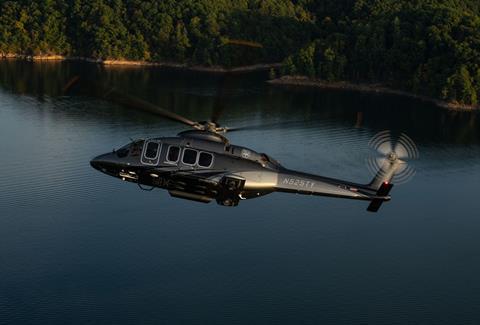
Bell has no immediate plans to follow Leonardo’s lead and launch its own civil programme but she sees “appetite” for the “flexibility of runway independence, combined with range and speed and a cabin size that that would make sense”, if it can be achieved at a reasonable cost.
“I would love to see that come to fruition, but we’ve got a few things we’ve got to get done first before we put a whole lot of energy into that.”
Included in Bell’s not-insignificant to-do list is its own certification headache: the 525 super-medium-twin helicopter.
Development of the 525 began in 2012, so long ago that it was launched not by Snyder, but by her predecessor’s predecessor, John Garrison.
The process has been hampered by a fatal crash during testing, a regulator stung by its failings elsewhere, and the challenge posed by the certification of the first civil helicopter to feature fly-by-wire controls.
Previous forecasts for the 525’s service-entry date have come and gone, and perhaps stung by these misses, Atherton will not say if it will be this year or next.
However, she discloses that Bell still has not begun the FAA’s 150h-duration function and reliability testing on the 525 – the final test flying in the certification campaign.
While she is acutely aware the validation process has taken “much longer than we would have wanted”, she maintains that all parties are “working closely together to make sure that this is the absolute best product out there.
“I have no doubt – and I’ve flown in it myself – that once we get through these final, final stages, it’s going to be a game-changer for the industry.”
Nonetheless, there are still questions over the industry’s appetite for the new platform; orders have been sparse and while the capability offered by the 525 looks genuinely appealing, it is unclear whether operators are willing to pay a premium over the current crop of super-mediums.
Atherton does not directly address whether she is content with the backlog for the type, but says she is “happy with what we are hearing from the market – they are really excited to receive it” and the capability it will offer.
However, she adds: “I also understand, from their perspective, they want to see the type certificate, so I fully recognise we’ve got to get through that step.
“So in terms of the product itself, I am ecstatic. We just we have to finish the process.”
Once that is out of the way, though, the question becomes: what next for Bell’s civil line-up?
Of all the models, the 412 – a helicopter that first flew in 1979 – looks most in need of replacement. Atherton does not disagree but, as you would expect, stops short of committing to a new programme.
Although stressing that she “does not want to get ahead of herself”, she sees potential to apply technologies matured on other programmes to a smaller platform.
“If you take some of the work that’s been accomplished… on our 525, there is some scalability there,” she says, adding that “there’s been a lot of work done inside of the portfolio to make sure that we continue to refresh our platforms.”
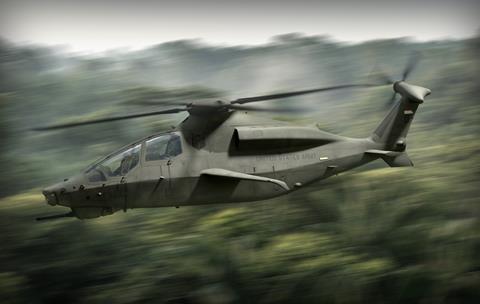
Besides the 525 – notably its fly-by-wire controls – Atherton highlights the possibility of leveraging work done on the MV-75 and Bell’s 360 Invictus proposal for the US Army’s now-cancelled Future Attack Reconnaissance Aircraft (FARA) programme. Perhaps of note was the fact the Invictus was to use a single 3,000shp (2,240kW) main engine supplemented with addtional power from a secondary 580shp turboshaft.
“There are capabilities across all of them that you could use as capability enhancements across the portfolio. There’s a lot of work done on FARA and the 525 that would yield itself into something very useful,” she says.
Interestingly, Atherton is more circumspect when it comes to the potential demand for low-carbon products.
It is not that there is no interest from operators, she claims, more that they are cognisant a battery- or hybrid-electric vertical take-off aircraft using current technologies will incur a certain range or payload penalty against a conventionally-powered equivalent.
What customers really want, she asserts, “is to ensure that they have an appropriately valued and priced product that allows them to perform their missions”.
And for much of the vertical-lift industry, that is a focus on “helping people in some of the direst situations. That’s why they’re so very focused on safety, reliability and performance.”
Therefore, while Bell will keep exploring new propulsion concepts, “because of what these platforms are used for, other things take priority: you have to make sure you have a platform that can be there when you need it”.
Which, when you think about it, is really all about keeping your promises.