















British developer Flyby Technology has been selected by the UK Ministry of Defence (MoD) to supply multiple unmanned air vehicles (UAVs) as part of an experiment to demonstrate the potential for autonomous systems to provide force protection on the battlefield.
Under the contract, signed last month, Flyby will deliver an initial Jackal UAV to the MoD before 31 March 2026, the end of the current financial year.

However, additional as-yet undefined systems will be developed as the capability demonstration effort evolves, says Flyby chief executive Jon Parker.
While the Jackal is “the right tool for the job” based on the initial intended outcomes, this may not hold true as the project progresses.
“It is a capability we are demonstrating not a platform,” he notes. “Today it’s the Jackal but we are not emotionally attached to it – it could be a completely different aeroplane in six months’ time.”
Through this project, the MoD will demonstrate the “Internet of Battlespace Things (Force Protection)”, a connected system designed to provide mobile firepower to deployed troops.
Flyby’s Jackal will serve as an “airborne effector” within that system, but crucially one that is able to respond to threats autonomously based on sensor inputs from other parts of the network.
While a ‘human in the loop’ will still be required to launch a strike, Parker believes this will change in the future, allowing UAVs to prosecute targets fully autonomously.
“We will need to have this capability, because our enemies certainly will,” he says.
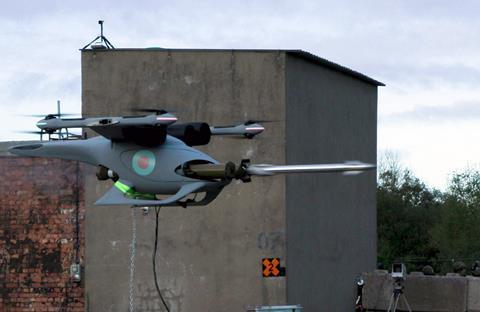
Meanwhile, Flyby continues to evolve its product range. To date, an all-electric vertical take-off and landing platform, the Jackal could in future be adapted with a hybrid powertrain to increase range and payload beyond current figures of 80nm (150km) and 50-65kg (110-145lb).
Similarly, the company is working on a larger variant, known as Havoc, that will also likely use hybrid power, enabling it to “carry heavier weapons further”.
In 2022 Flyby demonstrated the Jackal’s ability to carry and fire a pair of Thales Lightweight Multirole Missiles (LMMs).
Flyby has also previously hinted at other developments, including the Vandal hypersonic UAV designed for electronic warfare missions and Mayhem, a low-cost cruise missile/target drone.
Currently based in Yorkshire in the north of England, Flyby intends to establish a production line in Swindon in the southwest of the country, spurred on by the efforts of local MP Will Stone to turn the town into a drone manufacturing hub.
Should Flyby succeed in opening the new site, which hinges on securing investment, it will join fellow UAV manufacturers Tekever and Stark Aerospace in the town.
“We fully believe in Will Stone’s philosophy,” says Parker. “He’s emerging as a key player in the defence of our country.”