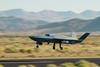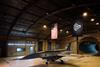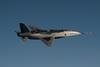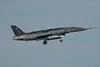













General Atomics Aeronautical Systems (GA-ASI) has completed the first flight with its new YFQ-42A Collaborative Combat Aircraft (CCA) prototype, a significant milestone in the US Air Force’s (USAF’s) quest to field an uncrewed fighter jet.
The company revealed on 27 August that it has begun a flight-test campaign on the YFQ-42A, which is one of two finalists to be the USAF’s first “FQ” designated aircraft.
The air force confirms the milestone, noting that the start of test flights comes less than two years after the formal launch of the CCA programme.
“This milestone showcases what’s possible when innovative acquisition meets motivated industry,” says US secretary of the air force Troy Meink. “In record time, CCA went from concept to flight, proving we can deliver combat capability at speed when we clear barriers and align around the war fighter.”
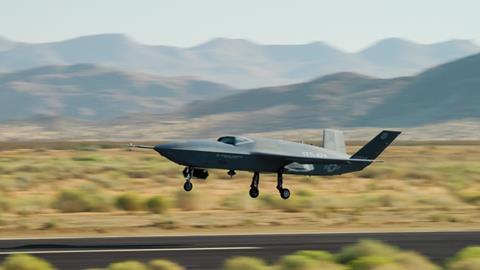
GA-ASI president David Alexander heralded the YFQ-42A’s maiden sortie as an “incredible achievement”, noting that it took just over one year for the uncrewed aircraft designer to build and fly the new jet.
“I salute the air force for its vision and I salute our development team for delivering yet another historic first for our company,” he says.
The inaugural flight took place at a General Atomics test site in California.
The YFQ-42A, which received its designation from the USAF, is derived from another GA-ASI aircraft – the XQ-67A. That type began flying in early 2024 independently from the CCA programme, likely helping to accelerate General Atomics’ development timeline.
The company had also spent five years training the autonomous flight software that now powers the YFQ-42A on a separate aircraft – the MQ-20 Avenger, another GA-ASI design.
Rival Anduril Industries, which is developing the competing YFQ-44A, said on 27 August that its own CCA prototype will also begin flight testing shortly. Anduril was first the first competitor to begin ground testing an aircraft in May.
“Congratulations to General Atomics and the US Air Force for kicking off flight testing for YFQ-42A – a major milestone on the path to fielding Increment 1 CCAs by the end of the decade,” says Jason Levin, senior vice-president of engineering, air dominance and strike at Anduril.
Anduril’s YFQ-44A is derived from the company’s Fury uncrewed jet, which represents the start-up’s first foray into high-performance jet aircraft.
The USAF says it hopes to conclude flight trials and make a competitive procurement decision before the end of the 2026 fiscal year, which concludes in September 2026.
The service is positioning the new class of fighters as a key pillar of its ability to establish air dominance in the future. Those semi-autonomous FQ jets will team with existing fourth- and fifth-generation fighter aircraft, and the forthcoming Boeing F-47 sixth-generation type.
“CCA will help us rethink the battlespace, extend reach, flexibility and lethality in combat operations, and optimise war fighter performance through human-machine teaming,” says USAF chief of staff General David Allvin.
The new class of aircraft will supplement manned aircraft with extra air-launched weapons and battlefield capabilities like electronic warfare. The US Navy also plans to begin integrating an uncrewed tanker aircraft into its carrier air wings in 2026.
Perhaps even more important than the specific capabilities CCAs will bring is their cost. The air force hopes the uncrewed fighters will be vastly more affordable than current designs like the Lockheed Martin F-35, which runs at around $78 million for the conventional take-off and landing F-35A model.
The F-47 is expected to cost orders of magnitude more, potentially beyond $200 million per aircraft.
By contrast, both General Atomics and Anduril have suggested a price below $20 million for their respective CCAs.
Such a reduced price tag could allow the USAF to field vastly more combat power, something it is struggling to do while simultaneously having to maintain a large fleet of ageing fourth-generation fighters and acquiring expensive new types like the F-35 and Northrop Grumman B-21 stealth bomber.