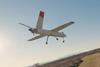
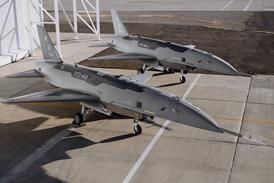








Boeing and the Royal Australian Air Force (RAAF) have shared additional details about the MQ-28A Ghost Bat’s first successful air-to-air missile firing.
The 8 December event involved the unmanned MQ-28A working alongside two Boeing F/A-18F Super Hornets, a Boeing E-7A Wedgetail airborne early warning and control aircraft, and an Airbus Defence & Space A330 Multi-Role Tanker Transport (KC-30A).
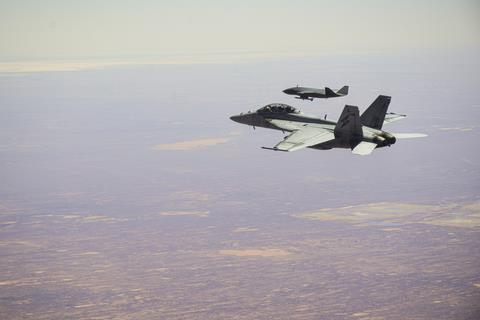
The aircraft launched from separate locations before converging to form what Boeing officials describe as a collaborative combat aircraft formation capable of executing an end-to-end kill chain. For the test, the MQ-28A carried a Raytheon AIM-120 Advanced Medium-Range Air-to-Air Missile (AMRAAM) on a pylon beneath the fuselage.
Colin Miller, head of Boeing’s Phantom Works advanced research unit, highlights the role of autonomy in the demonstration and notes that customers are increasingly focused on collaborative combat aircraft performing counter-air missions.
He says the MQ-28A can execute several preset mission profiles with minimal human input. During the test, the aircraft received only four major commands: take off, enter a combat air patrol, intercept a target, and clearance to fire. During the effort the MQ-28A was under the command of the the E-7A.
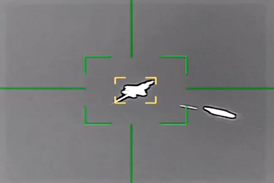
After one of the Super Hornets identified the target drone, it passed track data to both the E-7A and the MQ-28A. The E-7A crew assigned the shot to the MQ-28A, which then executed the engagement autonomously, including providing in-flight guidance to the AMRAAM via datalink.
Glen Ferguson, who leads Boeing’s MQ-28 programme, emphasises that a human remained in the loop to clear the actual weapons release.
For the purposes of data collection, the MQ-28A operated relatively close to the Super Hornets during the shot. In combat conditions the aircraft would likely be separated by dozens of miles, with the E-7A positioned well to the rear.
The full engagement sequence took about 10min because of test-range safety requirements, though Miller says that in an operational scenario data sharing and engagement would be nearly instantaneous.
“We had, as you’d expect, safety considerations about when we would release that really set the timing for the event, to make sure that we were in a shot box that had safe parameters and was within our clear fire zone based on the range safety policy,” says Miller.
Following the demonstration, Australia’s Department of Defence announced an additional A$1.4 billion ($928 million) investment that will fund six operational MQ-28A Block 2 aircraft, supplementing three already on contract. The first Block 2 airframe is poised to exit productoin and enter ground tests, with flight tests planned for 2026.
The programme will also move forward with a Block 3 prototype, incorporating lessons from the earlier aircraft and adding internal weapons bays.