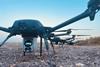














The US military is moving to dramatically expand access to small drones for its frontline combat units.
Unveiled by secretary of defense Pete Hegseth, the initiative will make two policy changes aimed at significantly increasing the number of small unmanned aerial systems (sUAS) in the US inventory and supporting the “nascent US drone manufacturing base”.
The changes include allowing tactical level commanders to directly purchase their own drones and significantly expanding the roster of UAS manufacturers whose products are approved for military use to include “hundreds” of US-made systems.
“Drones are the biggest battlefield innovation in a generation, accounting for most of this year’s casualties in Ukraine,” Hegseth said in a 10 July memo. “Our adversaries collectively produce millions of cheap drones each year.”
He adds that the US military is specifically lacking the quantities of lethal small drones needed for modern combat.

A 2023 report from the UK’s Royal United Services Institute (RUSI) estimated that Ukraine was expending approximately 10,000 UAS per month. A separate RUSI study released in February this year found that tactical UAS are responsible for 60-70% of all Russian battlefield losses.
Given their effectiveness, and high rate of expenditure, Kyiv has made the domestic production of drones a strategic imperative.
Analysis by the Georgetown Security Studies Review found that Ukrainian production of first-person point-of-view drones has dramatically increased throughout the course of the war, reaching 600,000 units in 2023 and soaring to 2.2 million in 2024.
Perhaps even more notable is that 96% of all drones deployed by the Ukrainian armed forces in 2024 were produced at home, rather than imported.
In Washington, the Trump Administration is seeking to replicate that success.
In June, President Donald Trump signed an executive order laying out a sweeping national strategy for expanding the use of UAS in both the civil and military sectors. That order included a directive to expand the Pentagon’s so-called UAS “Blue List” of drones and subcomponents that have passed industrial- and cyber-security reviews.
Although initially intended as an advisory tool, inclusion on the Blue List had become a de facto requirement for any UAS manufacturers seeking to sell products to the US military.
However, the small Defense Innovation Unit (DIU) office that manages the list has said it lacked the resources to keep up with the boom in drone production, meaning many newer platforms were struggling to even receive an evaluation.
In his 10 July memo, titled “Unleashing US Military Drone Dominance”, Hegseth ordered control of the Blue List to be transferred from the DIU to the Defense Contract Management Agency by January 2026.

The memo lays out a new framework in which officers in command positions with the rank of colonel will be able to nominate individual UAS for priority evaluation and certification on the Blue List.
Colonels (or captains in the US Navy) typically command large combat formations such as infantry brigades in the army; expeditionary combat units and infantry regiments in the Marine Corps; fighter, bomber, or mobility wings in the air force; and large ships or carrier air wings in the navy.
Those commanders will now be able to directly procure, test, and train small UAS that meet security certifications.
“While global military drone production skyrocketed over the last three years, the previous administration deployed red tape,” Hegseth says in his memo.
“I am rescinding restrictive policies that hindered production and limited access to these vital technologies, unleashing the combined potential of American manufacturing and warfighter ingenuity. I am delegating authorities to procure and operate drones from the bureaucracy to our warfighters,” the new policy directive states.
One-way attack UAS are specifically noted as a priority weapon system for the Pentagon, which now aims to equip every ground combat squad with “low-cost, expendable drones” by the end of 2026.
Priority will be given to units assigned to the Indo-Pacific theatre.