














The US Army is contracting with uncrewed aircraft manufacturer AV to provide drones for training soldiers on new aerial reconnaissance tactics.
AV, formerly known as AeroVironment, received a $13 million contract from the army on 8 December to provide an unspecified number of the company’s P500 uncrewed aerial systems (UAS) under the Long Range Reconnaissance (LRR) programme.
The three-year deal includes options that extend the contract to a potential value of $42 million.
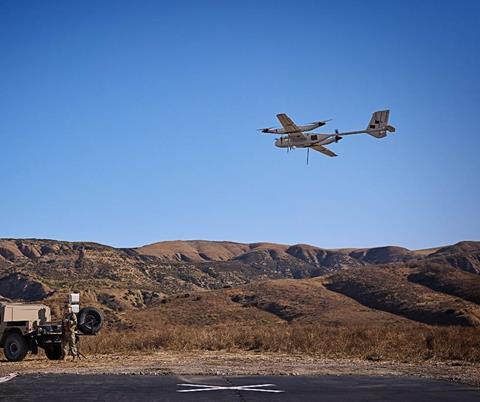
Under the LRR programme, the US Army is procuring multiple types of small UAS that will be used as surrogates for training soldiers on the operation and battlefield employment of drones.
In November, the service began receiving Edge Autonomy’s VXE30 Stalker, which will be used as an instructional device for two combat reconnaissance courses at the army’s aviation hub of Fort Rucker, Alabama.
The service announced in August that it had selected Edge Autonomy and AV to deliver uncrewed aircraft for the LRR programme under a rapid fielding initiative.
AV’s P550 is an all-electric, Group 2-sized UAS with vertical take-off and landing capability and autonomous flight. It can be outfitted with both intelligence, surveillance and reconnaissance sensors and lethal munitions.
The company unveiled the P550 design in 2024, teaming with open architecture software provider Parry Labs on a US Army proposal for the LRR initiative, which is pursuing UAS solutions for tactical-level ground combat units.
“AV’s LRR offering was engineered to meet the army’s unique needs, resulting in an architecture tailored to match battalion-level battlefield requirements,” says Jason Hendrix, AV’s vice-president of small uncrewed aerial systems.
“We are confident that P550 will effectively bridge the current capability gap, providing the army with critical functionalities in a single, adaptable platform,” he adds.
The LRR programme emerged after the cancellation of the Future Tactical UAS (FTUAS) development effort, which was axed earlier this year as part of a broad shake-up of the US Army’s aviation strategy.
That programme was launched to replace the Textron RQ-7B Shadow, which was retired in 2024.
In explaining the FTUAS cancellation, army leaders at the Pentagon and Fort Rucker said the development effort moved too slowly and produced designs that were already obsolete compared to commercially available technology.
While the service has not yet formalised long-term plans for a new tactical-level small UAS, the initial phase of the LRR effort is meant to ensure that American troops develop the skills necessary to operate such drones when they are eventually fielded.
The army says it is moving aggressively to incorporate small drones into its conventional rotary-wing aviation forces, saying the new generation of UAS will augment crewed aircraft, rather than replace them.