










An object that struck the windshield of a United Airlines-operated Boeing 737 Max 8 cruising over Utah on 16 October has been identified by the US National Transportation Safety Board (NTSB) as a high-altitude balloon used to collect atmospheric data.
Windborne Systems, the company operating the global sounding balloon (GSB), approached the NTSB following the mid-air collision to notify investigators that it had lost communication with one of its balloons in the vicinity of the 737, which was in cruise flight 36,000ft over Moab at the time of the accident.
The 737 Max 8, registered under N17327, was operating as flight 1093 between Denver and Los Angeles.
The aircraft’s captain told investigators that he noticed an object that appeared distant on the horizon, but the collision ocurred before he could draw the first officer’s attention to it.
“There was a significant impact on the FO’s forward windshield along with a loud bang,” the NTSB finds. ”The impact resulted in both pilots being showered with pieces of glass.”

While the captain ”sustained multiple superficial lacerations to his right arm”, the first officer was not injured by the glass spray. The captain treated his wounds in the cockpit before descending to the chosen diversion airport in Salt Lake City.
None of the 737’s other five crewmembers or 106 passengers were injured by the balloon strike.
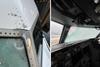
While images shared by the NTSB appear to show the aircraft’s windshield – made of thermally tempered glass and several protective layers of vinyl and other plastics – as a spiderweb of cracks, cabin pressurisation remained stable and did not fluctuate for the remainder of the flight.
”Windshields are certified to withstand the impact of a four-pound bird without penetration, to be capable of withstanding the maximum cabin pressurisation loads with the failure of a single pane, and the internal pane must be non-splintering,” the NTSB notes.
The damaged windshield was removed and taken to the NTSB’s materials lab in Washington, DC for inspection.

Following the accident, WindBorne Systems said the GSB had been released from Spokane, Washington on 15 October and had travelled over Oregon and Nevada before turning east into Utah.
Balloon launch operations in Spokane lost contact with the weather-sensing balloon just after 06:30 Pacific Time on 16 October, with a last reported altitude of 35,936ft.
The lightweight, long-duration balloon is filled with lift gas and is controlled by an onboard avionics package. It is equipped with communications technology, sensors and ballast for controlling altitude.