










US lawmakers are seeking to expand requirements for the use of Automatic Dependent Surveillance-Broadcast (ADS-B) systems on both civilian and government aircraft.

Senator Ted Cruz and other Senate Republicans on 29 July introduced a bill to mandate the changes in response to the 29 January midair collision involving a US Army Sikorsky UH-60L Black Hawk helicopter and PSA Airlines MHIRJ CRJ700 regional jet.

The bill came the week the National Transportation Safety Board (NTSB) held a three-day investigatory hearing into the January collision, which killed all 67 people on both aircraft.

UH-60 Black Hawk - PSA collision

Source: National Transportation Safety Board

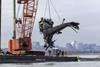
Crews on 6 February retrieved the UH-60L Black Hawk from the Potomac River following the deadly collision

The Federal Aviation Administration since 2020 has required that aircraft have and use ADS-B “Out” – a system that transmits an aircraft’s position and other details about its flight to air traffic controllers and to other aircraft.

But the agency does not require aircraft have the related ADS-B “In” function, which picks up data transmitted by ADS-B Out systems on other aircraft and presents that information to pilots. The FAA says ADS-B In, by giving pilots more information about nearby traffic, can help prevent collisions.

Cruz’s bill would require that, within five years, all aircraft have and use ADS-B In, and that newly manufactured aircraft be equipped with it.

The bill would also tighten an exemption allowing government operators to avoid the ADS-B Out requirement. That exemption applies to aircraft operating “sensitive government missions” – a designation the FAA allows government operators themselves to define.

The UH-60L that flew into the regional jet over the Potomac River on 29 January was operating a training mission and was not using ADS-B. Investigators say the helicopter had exceeded an altitude cap when it slammed into the passenger jet.

Not using the system became common practice for some military operators. According to a June 2023 USAF document, the Army Aviation Brigade at Fort Belvoir – where the doomed UH-60L was based – and Marine Helicopter Squadron One in Virginia operated “100% of their missions with the ADS-B off”.

Cruz’s bill would specify that a “sensitive government mission” does not include “any proficiency or training mission operated within Class B or C airspace, “unless such operation is for a national security event”.

The US Department of Defense (DoD) and other government agencies had pushed for the ADS-B exemption on national security grounds.

Such “concerns” remain, lieutenant colonel Paul Flanigen said on 1 August during the NTSB hearing.

ADS-B is “inherently open source… It has some spoofing vulnerabilities that make it non-conducive for those sensitive missions”, he says.

The UH-60L’s pilots did have iPads capable of displaying ADS-B In data. But the Army advises pilots against using iPads while flying visual-rule flights, when pilots should be scanning the sky for aircraft, US Army chief warrant officer David Van Vechten told NTSB investigators on 1 August.