












Alaska Air Group is scaling up cargo operations in pursuit of revenue from sources beyond passenger flights.
Newly introduced flights between Seattle and Tokyo are boosting the company’s cargo division, and executives see further freight-hauling potential thanks to Alaska Airlines’ acquisition last year of Hawaiian Airlines.
The addition of Hawaiian’s Airbus A330s and Boeing 787s is transforming the Seattle-based company’s cargo unit.
“The launch of our Seattle-Tokyo Narita route has rapidly expanded our international cargo capabilities from Asia’s third-largest market,” said Andrew Harrison, Alaska’s chief commercial officer, during the company’s 24 July earnings call.
“We’ve already passed our initial cargo-volume targets on this route… while there is still much to unlock,” he says.
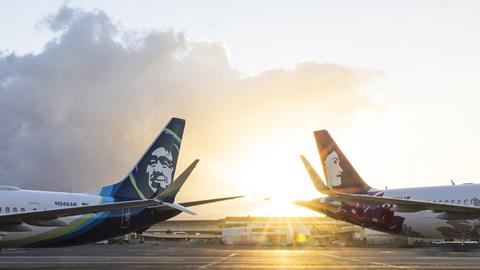
Alaska and Hawaiian deliver cargo to a combined 130 cities, including those within a large domestic US network and destinations Hawaiian serves in Asia and the South Pacific.
Aided by Hawaiian, Alaska Air Group is growing at its Seattle hub, with plans to serve at least 12 international cities from there by 2030. It has already revealed plans to fly to Seoul starting in September, with a new route to Rome planned to start in May.
Hawaiian’s fleet is proving useful on the domestic front, as well, as the Honolulu-based carrier recently launched twice-daily A330 flights between Anchorage and Seattle.
The company says one A330 has the cargo-carrying equivalent of two Boeing 737 freighters.
Alaska Air Group reports generating $139 million from cargo operations in the second quarter, a year-on-year increase of more than 90% compared with its $72 million cargo revenue figure from the prior-year period. The company had yet to complete its acquisition of Hawaiian in the second quarter of 2024.
Seattle-based Alaska plans to “scale and optimise” its cargo unit in 2026 and beyond.
Jason Berry, vice-president at Alaska Air Group and president of the company’s regional subsidiary Horizon Air, sees major growth potential for the cargo units at Alaska and Hawaiian. “We’re already seeing the synergies from the Alaska-Hawaiian combination,” Berry says.
Boosting freighter activity is part of Alaska Air Group’s plan to establish new revenue streams. The company is placing increased emphasis on revenue from its premium passenger segment and loyalty programme, aiming eventually for more than half its revenue to come from channels other than selling economy passenger seats.
Harrison calls cargo another ”key profit-growth engine for Air Group”.
Alaska Air Group’s combined fleet grew by 12 aircraft in the second quarter as it received three 737 Max 8s, four 737 Max 9s, one 787-9, two Embraer 175s and two A330-300 freighters.
Alaska Air Cargo, which serves the state of Alaska and Seattle and Los Angeles, took delivery of two 737s last year, for a total of five cargo-dedicated narrowbody jets. Berry says: “We’re bringing cargo directly to the mainland, to connect across the Lower 48 [states].”
Meanwhile, Hawaiian finally reached its long-planned 10-strong fleet of cargo-converted A330s that it operates on behalf of logistics provider Amazon, a partnership struck during the pandemic-related e-commerce boom earlier this decade.
While assembling the full fleet “took a while”, Berry says, “We’re beginning to see now that business start to finally spread its wings and really see what it can do”.