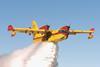













The Canadian province of Alberta has ordered five of De Havilland Canada’s in-development DHC-515 water bomber, padding the manufacturer’s backlog as it works to develop and introduce the updated firefighting aircraft.
De Havilland is producing the first three DHC-515s at its Calgary facilities and expects to have the type certificated in time to deliver the first, to Greece, in 2028.
Alberta will spend C$400 million ($292 million) to purchase the five aircraft and expects to receive the first in spring 2031, the province’s government said on 17 February when announcing the deal.
Alberta owns four of De Havilland’s earlier-generation CL-215 water bombers that were produced between 1986 and 1988, according to fleet data provider Cirium. The province intends to retain those aircraft, supplementing them with the incoming DHC-515s.

“Increasingly, we are seeing [fire] season become more volatile here in Alberta and across Canada,” says Alberta premier Danielle Smith. “The aircraft will help prevent fires from spreading into neighbouring communities.”
“It will inject millions of dollars into our economy, expand Alberta’s aerospace sector and support hundreds of new jobs,” Smith adds of the deal. “It reinforces Alberta as a leader in manufacturing.”
In 2022, De Havilland’s former sister company Viking Air – also owned by parent Longview Aviation Capital – launched development of the DHC-515, then called the CL-515, as an update to the CL-415, aiming to deliver the first by mid-decade. Longview merged the entities under the De Havilland name in the same year, at which time the CL-515 took the DHC naming convention. The development programme slowed amid the Covid-19 pandemic.
The aircraft has twin Pratt & Whitney Canada PW100 turboprops and Universal Avionics’ Insight touchscreen instruments. It will cruise at 187kt (346km/h) and carry 6,137 litres (1,621USgal) of water, says De Havilland.
Prior to Alberta’s purchase, De Havilland held orders for roughly 20 DHC-515s, from customers including the Canadian province of Manitoba and the governments of Croatia, Greece, Indonesia and Spain, Cirium shows.
“We are now in full-swing production,” De Havilland vice-president of corporate affairs Neil Sweeney tells FlightGlobal. “The first full wing-box is almost complete…everything is moving ahead well.”
In addition to the first aircraft destined for Greece, De Havilland has two other DHC-515s in early production stages, both due for delivery to France, Sweeney adds. The company produces the aircraft in Calgary.
Alberta has emerged as a major backer of De Havilland, which shifted toward the province in 2022 when winding down production of Dash 8 turboprops near Toronto.
That same year, De Havilland revealed plans to develop a new aircraft assembly and support site, with a runway, on land east of Calgary in sparsely populated Wheatland County.
De Havilland intends eventually to assemble DHC-515s and DHC-6 Twin Otters at the site, called De Havilland Field.
The company last year secured permits needed for development and this year “started moving dirt”, says De Havilland chief executive Brian Chafe.
By 2030, the manufacturer aims to be operating a parts distribution site, parts manufacturer facility and final assembly operation at De Havilland Field, Chafe adds.
The water bomber’s roots stretch to the 1960s, when original developer Canadair launched the piston-powered CL-215, with production in Quebec. Bombardier then acquired the programme before selling it to Viking, which rebooted production in Calgary.