











The Indian government has approved a major deal with domestic aerospace manufacturer Hindustan Aeronautics (HAL) for nearly 100 new fighter aircraft.
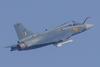
New Delhi gave final approval for the purchase of 97 HAL-built Tejas Mk1A combat jets on 19 August, an order valued at roughly Rs620 billion ($7.4 billion).
The development was reported by Indian news agency ANI, which says the decision by the government of prime minister Narendra Modi will allow HAL to move forward with production of the new jets.
The decision is a major win for HAL, which is preparing to deliver the first operational Tejas Mk1As under an earlier order from the Indian air force (IAF) covering 83 aircraft.
ANI reports the Tejas Mk1A will feature more than 65% indigenous content. That notably does not include the jet’s powerplant, a single GE Aerospace F404 turbofan.
In June, HAL chairman and managing director DK Sunil told FlightGlobal that access to the US-made engines has been a key factor in constraining production. HAL hopes to deliver 12 Tejas Mk1As this fiscal year, with a target of 24 jets annually going forward.
The Tejas Mk1A is meant to offset the looming retirement of the IAF’s aged Mikoyan MiG-21 fighters. New Delhi plans to reduce its full inventory of the Soviet-era interceptor, which stood at 36 aircraft at the start of 2025.

While the Mk1A offers improved capabilities as compared to the relatively limited Tejas Light Combat Aircraft (LCA) Mk1, the newer variant still fails to address India’s yawning fighter capability gap with regional rivals Pakistan and China.
In May, India suffered the loss of several French-made Dassault Aviation Rafale fighters at the hands of the Pakistani air force during aerial skirmishes.
That brief conflict revealed the effectiveness of Pakistan’s Chinese-made Chengdu J-10C fighters, particularly when paired with the long-range PL-15 air-to-air missile, which is also produced in China.
China has also helped Pakistan develop the Chengdu/Pakistan Aeronautical Complex JF-17, now flown in a Block III configuration with a Chinese active electronically scanned array radar and PL-15 capability.
More than 120 JF-17s were in frontline Pakistani service at the start of 2025, according to fleets data from aviation analytics firm Cirium.
Further worsening New Delhi’s position is the looming introduction of China’s low-observable AVIC/Shenyang J-35 type for both the People’s Liberation Army Air Force (PLAAF) and the Pakistani air force (PAF).
In June, Pakistani leader Shehbaz Sharif said Islamabad had received an offer from China for 40 J-35s. If the deal comes to fruition, it would make Pakistan the first overseas operator of the new Chinese stealth jet.
That offer reportedly also included an unspecified number of Shaanxi KJ-500 airborne early warning and control aircraft, which would further extend the PAF’s ability to develop long-range kill webs.
In addition to the J-35, China already operates around two dozen Chengdu J-20s – the country’s first attempt at a fifth-generation stealth fighter – likely in an air superiority role.
Little is known about the J-20, and multiple new combat jets have been sighted in skies over China throughout the past year. In March, the US Air Force said it believes at least one of those designs is also meant for air superiority.
A 2024 Pentagon report found the PLAAF is “quickly approaching US standards” in some key areas.

India, by contrast, has few options for fielding its own stealth aircraft to counter the regional partnership between China and Pakistan.
New Delhi’s proposed fifth-generation fighter, the Advanced Medium Combat Aircraft, remains in its very early stages, with a somewhat dubious service entry target of 2032.
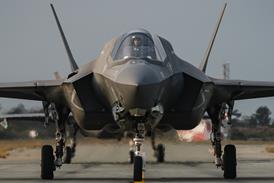
While US President Donald Trump earlier this year floated the prospect of India acquiring the American-built Lockheed Martin F-35 fighter, New Delhi has more recently rejected that idea, driven by Washington’s recent imposition of import tariffs on Indian goods coming into the USA.
Russia has offered its questionably-stealthy Sukhoi Su-57 to India, but has received little in the way of serious interest.
HAL’s most-advanced Tejas Mk2, a non-stealth design, is only set to arrive in large numbers in the 2030s, replacing obsolescent Sepecat Jaguars and Dassault Mirage 2000s.
The IAF aims to field 120 examples of the LCA Mk2.
Absent the F-35, no other fifth-generation fighters are in active production within the Western-aligned bloc. Two multi-national European consortia aim to deliver sixth-generation aircraft, but these face an uncertain future and are not expected to enter operational service before 2035 at the earliest.
Nearer-term prospects might include the Korea Aerospace Industries (KAI) KF-21, which is sent to enter frontline service with South Korea in 2026. This month, KAI also unveiled a concept for an improved KF-21EX variant with improved stealth features.
Turkey’s fifth-generation style Kaan fighter could be another option – although such a deal seems unlikely between the Hindu nationalist Modi government in New Delhi and Turkey’s longtime leader Recep Tayyip Erdogan, who espouses Islamic nationalism.
Turkish Aerospace is preparing to start flight-testing on the Kaan next year.
Given its limited options, New Delhi has instead focused on upgrading and building out its existing fighter force with what is available.
Over the last decade, India has added 36 Rafales acquired after the 2015 cancellation of the Medium Multi-Role Aircraft Competition (MMRCA). It has also inducted 36 of the earlier Tejas LCA Mk1s.
A major upgrade for 84 of India’s Sukhoi Su-30MKIs is also underway, with HAL modernising the type’s avionics, sensors and electronic warfare capabilities.
In 2024, HAL also won a contract for 12 new-build Su-30MKIs, but restarting production is expected to take 18 months to two years to restart, after assembly ceased at Nashik in 2019.
Other active production contenders for an additional Indian fighter buy of non-stealth types include more Rafales, the Boeing F-15EX, the Eurofighter Typhoon, Lockheed Martin’s F-21 (a rebadged F-16 Block 70/72), and Saab’s latest Gripen E/F.
Recent media reports suggest that India could expedite its fighter acquisition plans through a large acquisition of Rafales.