












Rapid additions of new Boeing 737 Max 8-200s are expected to significantly boost Allegiant Air’s full-year 2026 financial performance. 

That is according to chief executive Greg Anderson, who tells FlightGlobal that the jets are “performing well, both operationally and financially”, and are expected to continue providing margin and revenue tailwinds. 

“I’ll say it’s still early in the process, so we’ll keep a close eye, but we’re very encouraged by what we’re seeing,” he says. 

Allegiant expects roughly 10% of its full-year 2025 passenger capacity – measured in available seat kilometres (ASKs) – will come from flying its new Max 8s. That figure is expected to double as Allegiant believes about 20% of of its full-year ASKs will be generated by 737 operations in 2026. 

Reduced fuel burn compared with operating Allegiant’s older-generation Airbus A320s and A319s is providing a financial boost. Benefits are also accruing in the form of lower seat cost per departure. 

”What we’re seeing is roughly an earnings advantage of 25% or more with the Max fleet,” Anderson says. 

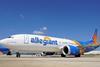
Allegiant Air Boeing 737 8-200

Source: Allegiant Air

Allegiant operates 10 737 Max 8-200s, a high-density variant of the Max 8, in addition to more than 110 Airbus narrowbody jets 

Allegiant took its first four Max 8s last year and expects to end 2025 with 16 of the latest-generation Boeing narrowbody jets in service, Anderson says. It has firm orders for a total of 50 737s and options for a further 80. 

Fleets data provided by aviation analytics firm Cirium show Allegiant currently operating 10 Max 8s. 

Currently, all the airline’s Max 8s are stationed either at Orlando Sanford International airport or St Pete/Clearwater International airport. Both of those aircraft and crew bases have mixed operations featuring both 737s and A320-family jets. 

Next month, Allegiant will turn its base in Fort Lauderdale into an all-Boeing operation, which Anderson describes as a self-contained ”airline within an airline” that will operate out-and-back routes with a single aircraft type.

“We think operating in that way helps mitigate some of the complexities of a dual-fleet type,” Anderson says. “It doesn’t eliminate it, but it does help mitigate it.” 

Anderson adds that the Max 8-200’s performance has been “outweighing the minor complexities that come from operating a dual fleet”. 

After years of delays, Allegiant began taking Max 8s in September 2024. Boeing has since consistently handed over jets to Allegiant ahead of schedule

With dozens more 737s on order, Allegiant will also keep wheeling and dealing mid-life A320 aircraft as opportunities arise. 

”We built the business on buying and trading used airplanes, and we’ll continue to keep a close eye on the A320 series, which is still the backbone of our fleet today,” Anderson says. “There are opportunities that may make sense for us.” 

Allegiant reported earlier in September that domestic demand across its leisure network is exceeding expectations in the third quarter, with ASKs trending 14% higher in August than the same month of last year. 

The Las Vegas-headquartered ULCC will likely report full third-quarter results in late October.