












The Phantom Works unit of aircraft manufacturer Boeing has unveiled a new autonomous tiltrotor concept aimed at military operators.

Dubbed the Collaborative Transformational Rotorcraft (styled as CxR in shorthand), the new offering is part of a broader trend within the vertical lift industry pivoting away from legacy, conventionally manned rotorcraft and toward autonomous designs – which are viewed as better suited to modern combat.

Boeing has early plans for two CxR variants, with the first being an armed “Collaborative Combat Rotorcraft” (CCR) option intended to support attack platforms like Boeing’s AH-64E Apache and AH-6 Little Bird.

A second configuration, dubbed the Collaborative Logistics Rotorcraft (CLR), will be oriented toward providing logistics support in contested environments alongside existing aircraft like Boeing’s heavy-lift CH-47F Chinook.

The various CxR derivatives will use common propulsion and autonomy control systems, but feature a modular fuselage tailored for specific missions like heavy-lift, medium-lift and armed reconnaissance.

Chris Speights, Boeing’s chief engineer for vertical lift, says the company expects the new designs will fall into the Group 4 or Group 5 category of uncrewed aircraft, meaning a maximum gross take-off weight of more than 600kg (1,320lb) and a flight ceiling potentially beyond 18,000ft.

“When we think about this vehicle, it has to have relevant range [and] relevant payloads for these types of missions to truly be collaborative,” Speights says. “That would enable it to fully support the types of attack, reconnaissance and scout missions that the Apache performs or needs to perform.”

Boeing unveiled the CCR concept on 13 October at the annual Association of the US Army (AUSA) conference in Washington, DC.

Boeing's Collaborative Combat Rotorcraft (CCR)

Source: Boeing

Boeing’s Collaborative Combat Rotorcraft is an uncrewed tiltrotor adapted from a broader company concept called the Collaborative Transformational Rotorcraft, or CxR, which is envisioned as a modular family of autonomous, multi-mission tiltrotors

The US Army is the largest single buyer of rotorcraft on the planet, including hundreds of Boeing’s Chinook and Apache types.

However, the service is in the midst of a significant restructuring of its aviation strategy, attempting to maintain the perishable industrial base that supports its existing rotary-wing fleet while also shifting toward the use of less vulnerable uncrewed aircraft.

That has left traditional vertical lift suppliers like Boeing and Sikorsky searching for new products to offer the army.

Ahead of AUSA, Sikorsky announced new plans for its recently named “Nomad” family of rotor-blown wing aircraft, including a flight test campaign for a Group 3-sized variant and a design for a larger Group 4 variant.

Sikorsky, which supplies the US Army’s most numerous rotary-wing asset – the UH-60 Black Hawk – also envisions both a “loyal wingman”-type armed role and autonomous cargo delivery for its Nomad family, likely setting up an industrial competition with Boeing’s CCR/CxR concept.

“We are sharing the concepts with the customer so that we can get feedback and tailoring to make sure that we’re homing in on the right problem statements and the right needs,” Speights says.

“All of our analysis shows that this is absolutely meeting the needs for this family of systems,” he adds. “Not an independent, but a collaborative [aircraft] that can really work with the other platforms that the army and other forces around the world have today.”

Boeing’s CxR concept is currently behind Sikorsky’s rotor-blown wing in the development pipeline, still being in the conceptual design phase, while Sikorsky is already flying a sub-scale Nomad demonstrator and ground testing a full-scale prototype.

However, Boeing plans to use its previous experience as a partner with Bell on the V-22 Osprey tiltrotor to rapidly advance the CxR concept to the point of operational viability within the next few years.

Speights says the current design calls for a single gas turbine engine powering two wing-mounted proprotors, which he says will support a rapid maturing of the design.

“We believe that that’s going to provide the most mature, rapid ability to field,” he says. “Any alternate propulsion systems, hybrid or otherwise, could be future evolution, but we really want to focus on simplicity, sustainment and fieldability to answer the needs that are really pressing right now.”

Sikorsky is notably pursuing hybrid-electric propulsion for its Nomad family.

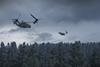
CV-22 Osprey c Bell

Source: Bell

Boeing says it will use its experience as a partner with Bell on the V-22 Osprey programme to develop a family of uncrewed tiltrotors that can fly nap of the Earth and hide behind terrain for frontline combat missions

Both companies need to secure new lines of business, as the US Army appears to be winding down purchases of existing, human-piloted rotorcraft.

Sikorsky is negotiating what is expected to be the army’s final multi-year procurement deal for new-build Black Hawks, while Boeing recently secured a long-sought contract to operationally field the latest CH-47F Block II to frontline army units.

Both firms are also working on plans for modernising currently serving rotorcraft, including the UH-60M and AH-64E.

Elsewhere in the world of rotary-wing aviation, Sikorsky and Airbus are offering cost-effective options for converting crewed helicopters into autonomous-capable vehicles, while Bell is on contract to provide the US Army’s next-generation MV-75 tiltrotor.

The service is also preparing to launch the Flight School Next competition for a new trainer helicopter and pilot instruction programme, which is attracting bids from all of the major players in vertical lift.

Bell, Lockheed Martin, Airbus, Leonardo, Robinson and MD Helicopters have all pledged to compete for the deal, either as the prime contractor service provider, the aircraft supplier, or both.

Boeing also jumped into the fray at this year’s AUSA, announcing on 13 October that it will partner with Leonardo to offer the AW119T.

Leonardo told FlightGlobal in July that it was seeking an industrial partner to act as prime contractor on a Flight School Next bid centred around the company’s TH-73 trainer – a derivative of the AW119k light-single used by the US Navy for rotary-wing instruction.