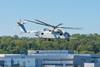














Rotorcraft manufacturer Sikorsky has received a nearly $11 billion Pentagon contract covering deliveries of the CH-53K heavy-lift helicopter across multiple years.

The $10.9 billion deal announced on 26 September by US Naval Air Systems Command (NAVAIR) covers up to 99 of the three-engined King Stallion helicopters for the US Marine Corps (USMC), deliverable over a five-year period from 2029 to 2034.

The award marks Sikorsky’s largest-ever order for the CH-53K.

The Lockheed Martin subsidiary says the combining of five individual orders contracts into a single multi-year deal will ensure consistent delivery of aircraft and ensure price predictability and consistent flow of materials for the King Stallion supply base, which includes 267 suppliers across the USA and 17 overseas supplies across eight countries.

Sikorsky CH53K 2025

Source: Sikorsky

Sikorsky has already delivered 20 CH-53K aircraft to the USMC, with an additional 63 aircraft in various stages of production and assembly in Stratford, Connecticut

Interested foreign military customers will also be eligible to secure orders from the total ceiling of 99 CH-53Ks.

“This multi-year procurement is key to mitigating programme costs,” says Colonel Kate Fleeger, manager of NAVAIR’s H-53 Heavy Lift Helicopters programme office.

The US Navy, which manages procurement for the USMC, says the move will also help save up to $1.5 billion in current production costs between 2025 and 2029.

“The contract allows Sikorsky to take advantage of a long-term, stable demand signal and bundle purchase orders from suppliers to achieve better pricing. That saving is then passed on to the government,” Fleeger adds.

The USMC is currently in the process of transitioning from the older CH-53E to the latest CH-53K King Stallion, which boasts the greatest payload capacity of any rotorcraft currently in the US military fleet.

Sikorsky has already delivered 20 CH-53K aircraft to the USMC, with an additional 63 aircraft in various stages of production and assembly under King Stallion Lots 4-8.

The latest five-year deal covers production on Lots 9-13.

“The multi-year contract enables Sikorsky to partner with the Department of the Navy to drive long-term affordability, optimise production efficiencies and stabilise our supply chain and workforce,” says Rich Benton, Sikorsky’s general manager.

Benton adds that the unique heavy-lift capabilities of the CH-53K will offer the USMC a “strategic advantage… in a rapidly evolving battlespace”.

To date, the USMC has stood up one CH-53K fleet squadron, with the remaining aircraft flying in various test and training roles.  

The service’s King Stallion programme of record covers a total of 200 aircraft.

Full-rate production on the CH-53K line was declared in 2022.

Sikorsky CH53K FinalAssembly Stratford CT

Source: Sikorsky

The King Stallion uses three GE Aviation T408 turboshaft engines to offer a payload of at least 12,000kg (27,000lb)

The CH-53K is the USMC’s first conventional helicopter to incorporate fully-digital, fly-by-wire flight controls. The Bell Boeing V-22 Osprey tiltrotor is also a fly-by-wire aircraft.

Basic requirements for the CH-53K were developed with a Pacific island campaign in mind. The USMC wanted an aircraft to launch from a ship, lift an external load of approximately 12,000kg (27,000lb) and transport that load at least 110nm (204km) ashore before returning to the assault ship.

That load weight roughly corresponds to a USMC Light Amphibious Assault Vehicle (LAV), which weighs 11,400kg.

According to NAVAIR the CH-53K has already exceeded those performance marks in real-world conditions. In 2022, a CH-53K landed an externally-loaded LAV at the summit of a 2,400m (8,000ft) ridge in the USMC’s 29 Palms training range in the California desert.

The King Stallion was also called to support a real-world search and rescue mission when a US Navy (USN) MH-60 Knighthawk helicopter, also made by Sikorsky, crashed high the Sierra Nevada mountains while searching for a lost hiker.

Navy officials determined no aircraft from the USN, USMC or US Army had sufficient lift to remove the 6,895kg load at an elevation of 3,657m.

The King Stallion uses three GE Aviation T408 turboshafts, rated at 7,500shp (5,520kW) each. At the time of the incident, the USMC told FlightGlobal that the high-altitude recovery mission was a good demonstration of the helicopter’s abilities.