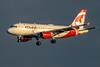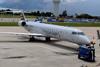












The failure of a China Eastern Airlines Boeing 777-300ER crew to heed a go-around call resulted in a runway incursion incident at Singapore Changi airport.
The event occurred on 28 August 2024 at 20:13 local time, according to the final report published by the Transport Safety Investigation Bureau (TSIB).

It involved two China Eastern aircraft, an Airbus A320neo (B-30AV) and the 777 (B-2021), both arriving from Shanghai Pudong.
Weather conditions were good at the time, with no precipitation, says the TSIB.
After landing on runway 20R, the A320neo was travelling too fast to vacate at exit 6, so the crew applied braking to vacate at exit 7. The controller had requested the aircraft use exit 7, and the crew read back this instruction correctly.
Meanwhile, the 777 had received clearance to land on 20R.
Recognising that separation between the taxiing A320neo and the landing 777 would be tight, the controller asked the A320neo to expedite its vacating. The A320neo crew, however, had already turned into exit 7 and applied manual braking, uncertain if they were cleared to proceed onto taxiway W.
The controller judged that the A320neo’s tail was clear of the runway edge line and that the aircraft was still in motion. The controller then instructed the crew to turn onto taxiway W immediately, while also calling on the landing 777 – by then at an altitude of 76ft altitude and 296m from the threshold – to go around.
“This was because the [controller] had re-assessed the situation and decided that [the A320neo] would unlikely be able to vacate the runway strip in time,” says the TSIB.
At this moment, the Advanced Surface Movement Guidance and Control System triggered a visual alert and aural alarm on controller screens.
The 777 did not acknowledge the go-around instruction and landed. The controller assessed that a go-around was no longer necessary as the A320neo’s tail had cleared the runway.
Both aircraft subsequently taxied to the terminal and parked without further incident.
When asked about the occurrence, the 777’s crew reported not hearing the go-around call. The report surmised that at the time the crew’s workload was very high and focused on the landing, while the jet’s Enhanced Ground Proximity Warning System (EGPWS) was making altitude call-outs.
“This go-around instruction was likely annunciated simultaneously with the EGPWS aural call-outs and might have affected the audibility of the [controller’s] transmission,” says the TSIB.
Moreover, the go-around call to the 777 was immediately preceded by a call to the A320neo, which may have contributed to it being missed.
After the incident, the Civil Aviation Authority of Singapore – the air traffic service provider – emailed controllers reminding them to be vigilant and “not hesitate to instruct a landing aircraft to go around when a potential loss of separation might occur.”
The occurrence has also been included in a case study, and a review of operations implemented.
China Eastern, for its part, reminded pilots to be vigilant for low-level go-around instructions.