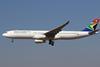












South African investigators have disclosed that an Airbus A330-300 pilot tried to stabilise an overspeed manually during a clear-air turbulence encounter, rather than leaving the autopilot engaged.

The South African Airways aircraft had been cruising at 41,000ft, en route from Cape Town to Johannesburg on 27 October last year, when it flew into the turbulent region.

It began to oscillate in pitch, says the South African Civil Aviation Authority’s investigation division.

With the speed trend vector increasing towards overspeed, the first officer disengaged the autopilot in a bid to stabilise the aircraft, despite flight manual recommendations to leave it active and to deploy the speedbrakes.

The first officer told the inquiry that the aircraft’s speed “remained steady” but the speed vector trended into the overspeed regime as the jet “porpoised downwards” and then trended into the lowest-selectable speed zone as it pitched nose-up.

Analysis showed that the aircraft – which had been cruising at M0.816 before the encounter – increased in Mach number to M0.875, exceeding the maximum operating Mach threshold of M0.86 for 9s.

Its rate of descent reached 2,176ft/min and its altitude “fluctuated” from 41,176ft to 40,404ft, the inquiry adds.

ZS-SXJ-c-AirTeamImages

Source: AirTeamImages

Flight manuals recommended that the autopilot be left active, and speedbrakes deployed, to resolve the situation

The first officer justified not using the speedbrakes by claiming their extension would have “compromised the margin” between the aircraft’s speed and the lowest-selectable speed threshold.

She said the autopilot was disengaged in order to hold the aircraft’s attitude level.

But the inquiry says her attempt to “settle” the attitude resulted in her “chasing the aircraft”, with a mismatch between the control input and the jet’s behaviour. It states that, on four occasions, the angle-of attack protection was triggered, while the first officer’s sidestick was pushed nose-down.

Data compiled by Airbus indicates that the aircraft experienced zero-g conditions during this period, it adds, which was “likely” to have been the point at which some of the flight attendants were injured.

Despite evidence that the aircraft exceeded maximum operating Mach, and triggered overspeed warnings, the inquiry says the first officer disbelieved the data obtained by investigators.

The captain testified to the inquiry that he assumed the first officer would use the speedbrakes, adding that the autopilot was disengaged without his being informed. He also said he was aware of the warnings, but did not intervene, feeling that the situation was still under control.

Simulation of the incident conducted by Airbus indicated that deploying speedbrakes, with the autopilot left engaged, would have led to a faster recovery, with the overspeed remaining within limits.

The crew opted to descend to 39,000ft in order to increase the speed margins and escape the unstable air.

Four cabin crew members were injured, one seriously, during the occurrence. The cabin service had started, and there was no turbulence warning from the cockpit.

“Some of the cabin crew members hit against the ceiling and other parts of the aircraft [while] others were burnt by hot beverages,” says the inquiry. “Contents in the food trolleys spilled to the floor and some trolleys and other catering equipment fell to the cabin floor.”

There were no injuries, however, among the 211 passengers.