














JetBlue Airways has modestly reduced expectations for its year-end operational performance in response to a trio of disruptions – Hurricane Melissa, the US federal government shutdown and the global grounding of Airbus A320-family jets.
The category 5 hurricane that pounded Jamaica in late October, along with a Federal Aviation Administration-mandated capacity reduction at major US airports to reduce strain on the country’s air traffic control system, were unexpected blows in what JetBlue still expects to be a strong fourth quarter.
The New York-based airline discloses in a 2 December filing with the US Securities and Exchange Commission that those two events combined resulted in a 1 percentage point reduction of JetBlue’s passenger capacity as measured in available seat kilometres. Non-fuel unit costs also took a hit of 1 percentage point.
Then came the extraordinary grounding of Airbus narrowbodies to address flight-data vulnerability to high levels of solar radiation. That grounding was prompted by an FAA directive to complete a software update issued on 28 November.
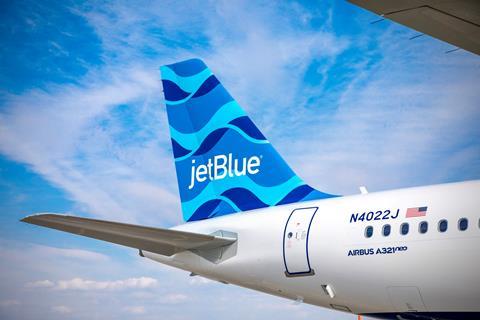
JetBlue was among the most-exposed carriers to the groundings in the Americas, as it operates a fleet of about 220 A320s and A321s. It cancelled about 170 flights on 30 November, the busiest US travel day of the year.
Hundreds of jets operated by American Airlines were also affected by the directive.
Airlines absorbed the disruption with seemingly minimal impact to their bottom lines, however. JetBlue says the event will likely cut its year-on-year ASK growth by .25% in the fourth quarter.
“The company continues to evaluate any potential financial impact,” JetBlue says.
The carrier’s overall financial expectations for the October-December period appears intact despite the unexpected headwinds.
”Demand during the fourth quarter has remained healthy, and fourth quarter bookings have been trending in line with expectations, except during the limited timeframe of the FAA emergency order to temporarily reduce flight operations due to the government shutdown,” JetBlue says.
JetBlue has struggled to be consistently profitable in the post-Covid-19 era, posting losses in seven of the past eight quarters, according to Airline Business data. The exception was JetBlue’s $25 million profit in the second quarter of 2024, which immediately followed a gruelling $716 million loss during the first three months of last year – results tied to the collapse of its previously planned acquisition of Spirit Airlines.
More recently, the company has embarked on a financial turnaround plan called JetForward, striking a more optimistic note. It expects to return to a growth phase in 2026, partially due to the easing of A320neo-family aircraft groundings related to Pratt & Whitney’s geared turbofan (GTF) recall.
JetBlue leadership also says the company is beginning to benefit from its Blue Sky partnership with United Airlines, an interline agreement that includes exchanging landing slots and gates at Newark Liberty International and John F Kennedy International airports.