













Mexican discounters Volaris and VivaAerobus have entered an agreement to form a new airline group under a holding company structure, which the airlines describe as a “merger of equals”.
Both companies boards of directors unanimously approved the new airline group’s formation, though the proposed deal still faces a shareholder vote, the companies said on 18 December.
If it passes regulatory approvals, the deal is expected to close in 2026. The group will be overseen by a board of directors featuring leaders from both Mexico City-based Volaris and Monterrey-based Viva, with current Viva chair Roberto Alcantara Rojas serving as the group’s board chairman.
Both airlines will maintain separate customer-facing brands and individual operating certificates. The deal, pending approval from regulators, is expected to close next year.
Branding of the new holding company is less clear, with the companies referring to it simply as the “Mexican airline group”.
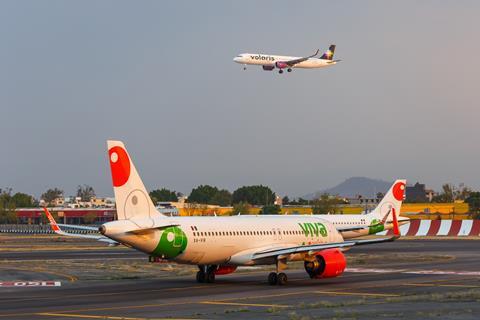
Viva chief executive Juan Carlos Zuazua acknowledges that the competitors have a “shared DNA and mindset” that makes a shared holding company appealing.
“Under the new group structure, Viva and Volaris will continue to operate as independent airlines, allowing our passengers to choose their preferred brand, their routes and preserve their loyalty programme and status,” Zuazua says.
Additionally, the carriers believe the tie-up will provide lower aircraft costs and improve access to capital, ultimately strengthening the financial positions of both Volaris and Viva.
But they maintain that they will stay focused on the low-fare, point-to-point model that has “revolutionised the industry over the last two decades”, according to Enrique Beltranena, Volaris’ CEO.
”The economies of scale and expanded distribution capacity will allow us to compete even more effectively in domestic and international markets by lowering fleet ownership costs,” he says. “This way, we will be able to offer ultra-low-cost fares to even more passengers as we pursue sustainable growth, benefit from a more efficient fleet, and lower costs.”
The deal calls for Viva shareholders to receive newly issued shares of the Volaris Holding Company.
“Volaris shareholders will continue to hold their shares, with each shareholder group owning 50% of the Mexican airline group on a fully diluted basis,” the companies says.
The combination as envisioned will boost the companies’ existing business models rather than remake the wheel, which they say will benefit Mexican air travellers.
“By creating a new holding company, Volaris and Viva will be able to grow their fleets, open new routes and offer more ultra-low-cost flights to more destinations,” says , executive vice-president of Volaris.
”This positions the group for accelerated growth.”
Additionally, the carriers believe the shared holding company will improve access to capital, ultimately strengthening the financial positions of both Volaris and Viva.
Notably, the Mexican – both all-Airbus operators – have struggled mightily with grounded Airbus A320neo-family jets as they both work through & Whitney’s years-long geared turbofan (GTF) recall.
Both are among the hardest-hit airlines in the world by the widely disruptive GTF recall.
Fleets data provided by aviation firm Cirium show that Volaris has 40 and listed as in ”storage”, which means they have been grounded for more than 30 days. Volaris has about 110 aircraft in service.
Meanwhile, Viva has nearly 100 Airbus jets in service and 25 aircraft in storage.
Considering the high number of aircraft Volaris and Viva can expect to return to service within the next two years – not to mention each carrier’s orderbook for new Airbus aircraft – the airline group’s combined fleet could approach 300 jets before decade-end.
That would make the Mexican airline group one of Latin America’s most-formidable regional forces, though it would still trail the fleets fielded by LATAM Airlines and Abra Group.