















Boeing is seeking US authorisation to continue selling its 777F cargo twinjet beyond the end of 2027, because its 777-8F will not be available in time to replace it.
Under FAA regulations aircraft which exceed certain fuel-efficiency limits will no longer be eligible for airworthiness certificates after 31 December 2027.
Boeing acknowledges that the 777F “exceeds” the set fuel efficiency limit but, in a 19 December communication to the US Department of Transportation, it says its more-efficient successor – the 777-8F – will “not be available” before the 2027 deadline expires.
The airframer is requesting permission to sell 35 additional 777Fs, which would otherwise be denied authorisation.
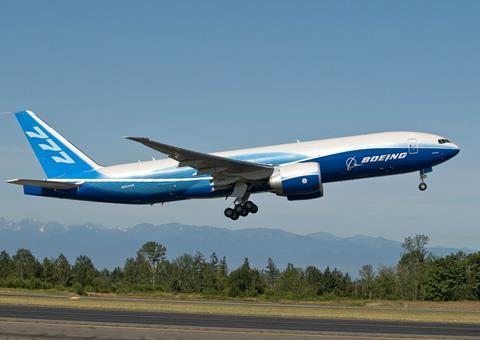
“Additional 777Fs are needed after [1 January 2028], to maintain an uninterrupted supply of large freighters to the market prior to the introduction of the 777-8F,” it says.
“The requested relief will allow Boeing to meet anticipated customer demand and support the substantial public interest in the sustained transportation of air cargo prior to the 777-8F entering service.”
It is hoping to secure the exemption by the beginning of May next year.
Boeing argues that the air freight market “relies” on the 777F – which is powered by GE Aerospace GE90 engines – to connect major cargo hubs.
“With the dramatic growth of e-commerce and challenges in the maritime sector, the global air cargo industry continues to experience a capacity shortage in large widebody freighters,” it points out.
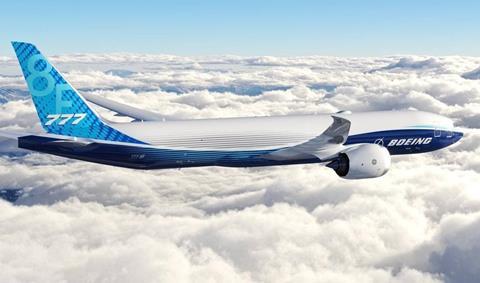
It also says the 777F is the only high-capacity freighter in production, and maintaining continuity to the 777-8F is “critical” to the economic stability of the programme.
Airbus is developing the A350F as a rival to the 777F, and is aiming for service entry in the second half of 2027.
Boeing claims that, without access to new 777Fs, operators will continue to use older in-service models – effectively thwarting the fuel-efficiency improvements which the 2027 regulatory change is attempting to deliver.