
















RTX is pitching the Trump administration a fully integrated stack of air traffic management technologies for the government’s ambitious planned overhaul of the US air traffic control (ATC) system.
The company hopes to secure a sizeable portion of the $12.5 billion Congress allocated for ATC modernisation in last year’s “One, Big, Beautiful Bill Act”.
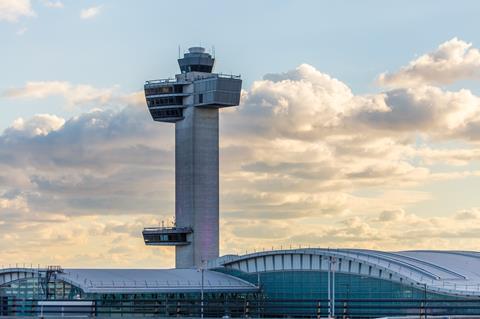
RTX, whose systems already help controllers manage roughly two-thirds of global airspace by the company’s estimate, recently won a $438 million contract to replace hundreds of radar systems across the US. Its Collins Aerospace division will deliver the radars.
“We have that full suite of sensing solutions that we can combine with the intelligence from an avionics perspective, and we essentially do the same thing on the air traffic,” says Nathan Boelkins, president of Collins’ avionics unit. “It’s all things intelligence and sensing solutions, and all things in between.”
The end product, Boelkins says, is a single solution to air traffic management that can give controllers access to more data while better filtering out “noise” in the data stream, helping them to do their jobs better.
The systems, he adds, can be scaled up to accommodate large numbers of unmanned drones and electric vertical take-off and landing (eVTOL) aircraft now under development for urban air transport.
An integrated, scalable, adaptable solution for the national airspace system (NAS) is the focus of the Federal Aviation Administration’s ATC overhaul.
“The current state of the NAS right now is highly variant, highly co-dependent, highly inoperable systems between ATOPs and ERAMs and STARS,” FAA administration Bryan Bedford said at a January industry lunch in Washington. “We’ve got a lot of great technology for this particular application – none of it is knitted well together.”
ATOP stands for Advanced Technologies & Oceanic Procedures, ERAM for En Route Automation Modernization, and STARS for Standard Terminal Automation Replacement System. The latter two track and control aircraft in US airspace.
The FAA in December contracted with US technology firm Peraton to oversee the government’s ATC modernisation programme as prime integrator. And in January the agency hired RTX and Indra, a Spanish firm with extensive US operations, to replace 612 ATC radars.
The radar replacement contracts cover primary and secondary systems, says Nicole White, vice-president and general manager of connected aviation at Collins.
Primary radars (also called “non co-operative” radars) are traditional systems using radio signal reflections to track aircraft, while secondary radars (called co-operative radars) track aircraft using broadcasts emitted from aircraft.

White declines to specify how many radars are planned for replacement, or where those radars are to be installed, directing questions to the FAA.
Many pieces of the ATC overhaul plan remain outstanding. One is the FAA’s adoption of a new “common automation platform” intended to “replace the current en route and terminal systems with a single state-of-the-art platform for air traffic control”. The agency released a request for information in November 2025.
RTX executives acknowledge the RFI but refer questions about it to the FAA.
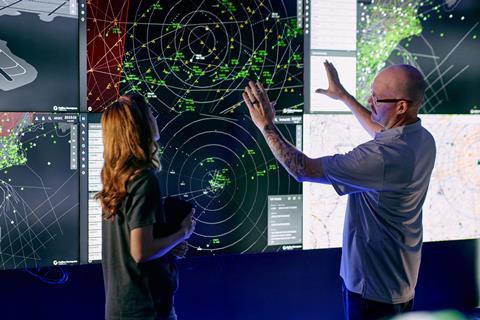
At a demonstration lab this week in RTX’s Washington offices, Cedric Vigil, Collins associate director of programme management, outlined how various functions sought by the FAA could be integrated under a single Collins platform. A wall of screens show various data views – including for oceanic, en-route and approach air traffic – that compose RTX’s single technology offering.
A single controller’s “interface… terminal is a window into the total system, as opposed to being a representation into one segment of the system”.
RTX executives decline to comment either about the timeline for deploying radars for the FAA or about their expectations for other aspects of the FAA’s air traffic control overhaul.
The Trump administration has set an ambitious target of completing the upgrades by 2028, roughly the end of Trump’s term.
Moving at that speed, Bedford said in January, requires the agency shift from a Boeing-like innovation cycle (meaning one involving updates happening over decades) to one more akin to that of Apple or Tesla (meaning technology updates coming annually or faster).
“It’s a mind shift… here at the FAA, but it’s achievable,” he said.