









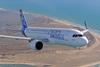

Investigations into an October in-flight upset involving a JetBlue Airways Airbus A320 have yet to reach any firm conclusions, but suspicions of a solar particle strike have proven sufficient to order an extraordinary temporary grounding of half the world’s A320-family fleet.
Remedial work ordered by safety regulators – notably the European Union Aviation Safety Agency and US FAA – has been quick, and several affected airlines had restored their aircraft to operational status within a few hours.
The JetBlue aircraft experienced an uncommanded pitch-down event in cruise during a Cancun-Newark service on 30 October.
Analysis of the occurrence led Airbus to express concern that “intense solar radiation” could corrupt data, and affect flight-control functions.
EASA has instructed operators, through an emergency directive, to uninstall the L104 software standard for the ELAC B elevator aileron computer hardware, and revert to the L103+ version. The FAA has also issued its own corresponding order.

Airbus introduced the L104 update as part of its ‘Safety Beyond Standard’ initiative, which aims to upgrade A320 capabilities – particularly in abnormal conditions – to a level similar to those of the A350.
This initiative is intended to reduce exposure to various threats, including in-flight loss of control – the primary driver behind the L104 standard, which is designed to enhance flight-envelope protection.
The new software standard for the ELAC B computer introduces pitch attitude limitation in alternate flight-control law, in order to delay the onset of potential stall. It also retains envelope protection in case of certain system failures.
Airbus has made the L104 enhancement available through service bulletins for both older-variant A320s and the A320neo family.
The airframer has not disclosed the specific evidence for a possible solar-radiation vulnerability that lies behind the urgent EASA and FAA safety directives.
But a cosmic particle strike has previously been considered as a triggering event to in-flight upset: the sudden pitch-down of a Qantas Airbus A330 during cruise in October 2008 was linked to intermittent incorrect data spikes provided by one of the air-data inertial reference units.
The Australian inquiry into the A330 upset was unable to determine conclusively the trigger for the air-data failure, but could not rule out a so-called ‘single-event effect’ – disruption of the digital state of an electronic component from the impact of a cosmic particle.
Earth’s upper atmosphere is subjected to a constant stream of radiation from sources in space, including the Sun, creating a cascade of particles. Neutrons, in particular, can affect the avionics of aircraft at cruise altitudes.
“A cosmic ray interacting with a molecule in the atmosphere can generate a multitude of charged and uncharged particles,” says EASA in an April 2021 safety bulletin.
“Studies also indicate that thermal neutrons, which are generated after many interactions of cosmic rays, have the potential to cause…bit flips in computer systems.”
EASA points out that the susceptibility of avionics has increased as a result of decreasing size of integrated circuit components.
It says aircraft at higher altitudes and latitudes are most likely to be affected, owing to increasing particle flux density caused by reduced atmospheric absorption and deflection of radiation towards the poles by Earth’s magnetic field.
EASA sets out guidelines for airframers to demonstrate mitigation of single-event effects in certification memoranda. Single-event effects can be transient and difficult to reproduce, the regulator says, but they can impact such critical functions as fly-by-wire, the autopilot, navigation and communication systems, and the full-authority digital engine control.