
















News on 28 November that regulators grounded, however briefly, thousands of the world’s most-popular airliners sent shockwaves through an industry already reeling from years of supply chain and production problems.
It also served to highlighted another consequence of the Airbus-Boeing duopoly: the degree to which problems affecting one aircraft type can cause global disruptions.
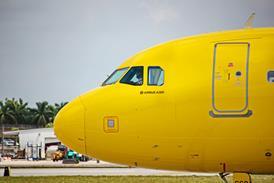
Last week’s emergency airworthiness directive from EASA, quickly mirrored by the FAA, targeted A320-family jets – some 6,000 of them.
EASA ordered the aircraft grounded until airlines replaced relatively new software for the elevator aileron computer with a prior version.
Airbus introduced the software as a safety measure intended to provide better flight-envelope protections. Turns out it was not ready for prime time, being vulnerable to data corruption – an issue Airbus discovered after a JetBlue Airways A320 experienced an in-flight upset on 30 October.
Mercifully, the grounding was far less disruptive than might have been expected, thanks to a quick software fix. Some airlines were seemingly ahead of the game, having co-ordinated with Airbus about the issue prior to it becoming widely known.
Within hours of EASA’s order – and even before the FAA’s – American Airlines said it had completed software downgrades to 59 of 209 affected Airbus jets. Its work mostly wrapped up the next day. United Airlines said just six of its jets were affected.
European budget airline Wizz Air, entirely dependent on A320-family jets, had to fix 83 aircraft, a third of its fleet – but managed it while claiming zero flight cancellations.
Not all airlines got off so easy. On 2 December, Abra Group CEO Adrian Neuhauser said subsidiary Avianca still had two dozen A320-family jets down, causing “very significant” impacts.
Still, the speed by which the grounding cleared up proved remarkable. By 1 December, Airbus said fewer than 100 affected jets still needed work.
But the outcome could have been much different.
Airlines have long bemoaned the Airbus-Boeing duopoly, wishing a third competitor would arise to provide fresh competition. Last week’s events provide another reminder of why another supplier might be a good idea.