














Canada’s Horizon Aircraft is confident that assembly of the first full-scale prototype of its Cavorite X7 hybrid-electric vertical take-off and landing aircraft will be completed by the end of the year, leading to ground testing in early 2027.

Speaking to investors on a second-quarter results call on 14 January, chief executive Brandon Robinson said the company had made “strong progress in recent months on the X7 programme”.

Cavorite X7-c-Horizon Aircraft

Source: Horizon Aircraft

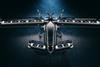
Cavorite X7 will take off vertically thanks to fan-in-wing configuration

He says Horizon is in “active discussions” with its aerostructures suppliers and is hopeful that large parts, such as the wing, fuselage, empennage and tail could begin arriving “during the summer and into the fall”, allowing final assembly to commence.

In parallel, tests of systems and sub-systems are ongoing, including the vertical propulsion system, an array of 14 ducted electric fans housed in the wing and canards.

“We also have the [Pratt & Whitney Canada] PT6 engine that we will be spinning up pretty soon,” he says. The PT6, configured with a pusher propeller, is used to power forward flight and to generate electricity for the wing fans.

If all proceeds on schedule, Horizon will have “a full-scale prototype ready for ground testing at the beginning of 2027”, says Robinson.

Critical challenges to overcome will be around the testing of the power electronics and batteries, alongside the development of the fly-by-wire control system, which is a “complicated problem to solve”, says Robinson.

And while the developer has “significantly expanded” its engineering team – doubling it year on year – hiring enough additional technical staff in a timely fashion is another potential pinch point, he adds.

Horizon last year completed flight tests of its uncrewed Cavorite X5 – a scaled version of the eventual production aircraft – with lessons from that campaign informing the design of the X7.

As of 30 November, Horizon had $24 million in cash or cash equivalents on hand, having “significantly improved” its liquidity position over the last quarter, bringing in some $11 million, leaving it with its “healthiest balance sheet ever”, says chief financial officer Brian Merker.

This will be sufficient to fund the company’s development actitives for the next 12 months, its accounts disclose.

In the meantime, the firm continues to evaluate potential strategic partnerships – both financial and industrial – to further bolster its position.

Robinson says “meaningful strategic discussions are underway” and is hopeful these can “push forward” this year. However, given Horizon’s liquidity position, it feels “no pressure” to enter into “suboptimal finance discussions”.

“We are encouraged by the level of interest [in Horizon] but we will wait for the right opportunity at the right time.”

The Cavorite X7 will be capable of flying up to 430nm (800km) at a speed of 250kt (450km/h), carrying six passengers plus one pilot or a 680kg (1,500lb) cargo load. Horizon sees the aircraft as suitable for civil and military applications.

Certification and service entry are targeted by the end of the decade.