














German researchers have begun a series of flights to measure the contrails produced by the latest-generation engines as part of a wider project tackling aviation’s non-CO2 impacts.
Led by Germany’s DLR aerospace research centre, 17 partners from nine countries are working on the A4CLIMATE project to reduce the formation and climate impact of contrails.
These goals will be achieved through new engine technologies, smarter flight routes and alternative fuels, it states.
While much of the project is focussed on the use of technologies to route aircraft away from areas where contrails are forecast to form, DLR is also analysing the performance of the latest-generation of “low-soot, lean-burn” engines.
Soot and other volatile particles in the exhaust stream play an important role in the creation of contrails by providing nuclei for ice crystal formation.
However, as the DLR points out: “It is still unclear whether less soot automatically means fewer contrails.”
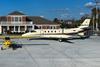
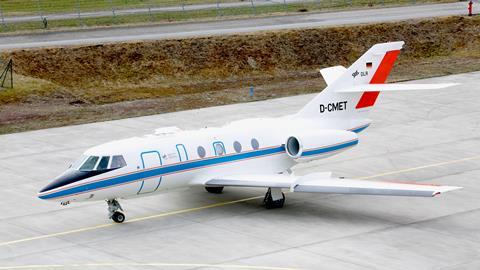
To verify that theory, the DLR is using its Oberpfaffenhofen-based Dassault Falcon 20E research aircraft to follow TUIfly passenger jets on routes that “deliberately pass through regions that are prone to contrails” between Germany and Egypt.
During the two-week campaign, the Falcon 20E will fly around 5nm (10km) behind selected TUIfly flights, measuring the contrails to determine their properties.

DLR researchers hope to establish how soot particles in the exhaust plume change over a period of up to 30min and how they influence contrails.
The data collected will then be used to further improve engine and contrail modelling and to refine forecasts.
“We want to understand how much global warming can be reduced when aircraft are more modern and smarter,” says project manager Christiane Voigt from the DLR Institute of Atmospheric Physics.
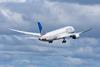
The DLR has not disclosed which aircraft type it is following for the tests, but the newest jet in TUIfly’s fleet is the CFM International Leap-1B-powered Boeing 737 Max.
In addition, the project hopes to develop a fully automated data feed to provide real-time route recommendations and offer immediate feedback on whether a flight can be planned in a more climate-compatible manner. Satellites will later verify whether the strategy actually produces fewer contrails.
But rerouting an aircraft to avoid contrail formation can result in in a longer flight, burning more fuel and producing more CO2.
To reduce any ambiguity, the project will also calculate the net climate impact of any route change.