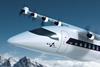







French start-up Aura Aero has opened a new assembly and operations centre in Florida, a move intended to fuel expansion and position the company to certificate and sell its in-development 19-passenger hybrid Electric Regional Aircraft (ERA).
“It was very important since day one within Aura that we needed to grow simultaneously between Europe and the US,” president and co-founder Jeremy Caussade tells FlightGlobal. “We need to have the FAA involved as soon as possible.”

Aura on 29 October marked the opening of a 1,022sq m (11,000ft sq) site adjacent to Daytona Beach International airport on Florida’s east coast. It has leased the facility from Embry-Riddle Aeronautical University and secured $200 million from the state of Florida to help outfit the site.
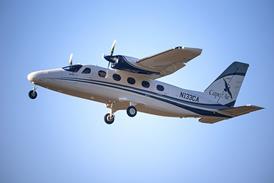
Aura was founded in 2018 and last year achieved European certification for its first aircraft, the two-seat Integral R, a trainer-acrobatic type powered by a single Lycoming AEIO-190 piston engine. It now produces Integrals at its site near Toulouse.
The Daytona Beach site will house a second Integral assembly line and customer support and aircraft-delivery functions, Aura says. It expects to begin Integral assembly in the USA next year with the first of those those aircraft being delivered to US company Mike Goulian Aviation before 2027.

Aura further envisions opening 500,000ft sq line in Florida in 2028 for assembling ERAs, supporting its main French production site. Certification is targeted for 2029.
The company sees an immense opportunity to sell Integrals in the USA, which has the “largest training market in the world, with nearly 600 FAA-approved flight schools”.
Having a US presence will also “lay the groundwork for” the ERA project and, in Caussade’s words, “raise the awareness of the FAA… that we are not a ‘paper’ company”.
Aura is now pursuing Federal Aviation Administration validation of EASA’s Integral R certification, while also seeking European certification of two other Integral models: the tricycle-landing-gear Integral S in 2025 and the all-electric Integral E in 2026. FAA validation of both should then follow.
Despite the E’s unique configuration, Caussade predicts a smooth approval, noting EASA has already certificated the type’s 125kW (168hp) Safran ENGINeUS 100 electric motor.
“We have already the design organisation approval, the production organisation approval, the type certificate of the basis of the plane,” he says. “The work that remains to be done is really associated to the powerplant modification.”

Caussade insists the experience and credentials Aura gains from the Integral programme positions it to succeed with the more ambitious ERA project.
“The two-seater is really a cornerstone of the plan,” he says. “The most important thing is to do it step by step… I [would] be in a very, very tough situation right now if I had only the 19-seater.”
A “plug-in” hybrid-electric commuter aircraft, the ERA will have eight wing-mounted propellers powered at least initially by eight Safran ENGINeUS motors matched to two turbogenerators.
It will have 900nm (1,667km) of range, 300kt (556km/h) cruise speed and ability to take-off and land in as little as 800m (2,625ft), Aura says.
“The final design is now frozen,” Caussade adds.
French electricity firm EDF, an Aura investor, will supply the ERA’s charging equipment.
Aura intends to work both with EASA and the FAA in securing the ERA’s certification, rather than seeking FAA approval through the validation process.
Aura has secured letters of intent covering possible future orders for some 650 ERAs. Competing start-ups Heart Aerospace and Maeve Aerospace are likewise developing hybrid regional airliners, albeit their designs are larger, holding 30 and 90 passengers, respectively.
Aura has about 300 employees and has been working off about €100 million ($116 million) in initial funding but is “not so far off” from raising another $100-200 million to help finance the ERA, Caussade says.
It expects this year to disclose the ERA project’s full list of suppliers and also to start manufacturing components, including fuselage, landing gear and carbonfibre wings. Four test aircraft are envisioned: the first for evaluating flight handling and electric systems, one for systems validation and two for cabin evaluations and customer demonstrations.
“I believe that we are still on track to have certification by 2029, and we expect between six to eight months between the type certification and the entry to service,” Caussade says.