
















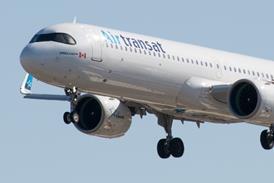
MHI RJ Aviation, owner of the CRJ regional jet programme, insists airlines need not rush to replace hundreds of ageing small jets, saying 50-seaters will remain active until 2040 and that no other aircraft match their capabilities.
The Mitsubishi Heavy Industries division, which acquired the CRJ programme from Bombardier in 2020, is making that case after Franco-Italian turboprop maker ATR, which is pitching its aircraft to US airlines, recently predicted those carriers will retire most 50-seat jets within 10 years.
“Fifty-seaters are here for 15 years,” MHI RJ senior vice-president of strategy and business development Ross Mitchell tells FlightGlobal, adding that the jets could theoretically fly longer if subjected to service-left extension programmes.
“The airlines are taking them through the mid-life checks [now]… Their intent is to keep the CRJs as long as possible,” Mitchell says. “They meet a market demand.”

Years after production stopped, CRJ200s and Embraer ERJs remain stalwarts in the fleets of US regional airlines. They are also to some degree irreplaceable; no Western manufacturers still produce 50-seat jets, and though start-ups like Maeve Aerospace and Heart Aerospace are developing clean-sheet regional jets, such projects are uncertain and years from completion.
US passenger airlines still operate some 380 50-seat jets, including 210 ERJs, 90 CRJ200s and 80 CRJ550s, a 50-passenger variant of the typically 70-seat CRJ700, according to fleet analytics provider Cirium.
CEOs from US regional airlines this month confirmed they have no intention to retire the jets soon.
“We plan to continue utilising the CRJ fleet well into the next decade,” SkyWest chief executive Chip Childs said this month. SkyWest Airlines operates among the USA’s largest CRJ200 fleet. Asked what aircraft might eventually replace its CRJ200s, Childs cites both CRJ550s and the hybrid-electric jet being developed by Maeve, with which SkyWest recently partnered.
Another US carrier, CommuteAir, intends to operate its ERJ145s at least until the end of this decade, as no replacements exist, said its CEO Rick Hoefling. The executives were not more specific about when the 50-seaters might be gone for good.
ATR’S PITCH
Several US regional airline chiefs attended an ATR marketing event this month in Washington, DC, where the turboprop maker predicted US carriers will retire essentially all their small jets within one decade, with groundings peaking in 2028 or 2029. ATR’s forecast assumes most of the jets will be retired before logging 45,000 cycles.
CRJ200s operated by US carriers have logged an average 41,200 cycles, while CRJ550 and 700s have logged 32,100 cycles and ERJs have accumulated 35,300 cycles, Cirium shows.
Mitchell says CRJ200s can fly to 60,000 cycles and CRJ550s and 700s can hit 80,000.
MHI RJ has also recently seen more demand at its shops for CRJ200 maintenance, a consequence of airlines returning to service jets they had placed into storage several years ago amid an acute pilot shortage. “There’s actually a bolt right now of demand,” Mitchell says.
The US fleet of stored CRJ200s stands at nearly 200 aircraft; those have accumulated an average 34,500 cycles, Cirium shows.
ATR is trying to entice US airlines to order 72-600 turboprops, highlighting a 50-passenger configuration with first-class seats and a proposal to give ATRs a forward boarding door (they currently have only rear-boarding doors). ATR says its aircraft will cost 30% less per seat to operate than 50-passenger jets.
Some airline CEOs say ATR makes a compelling case, while still expressing concern US fliers might view turboprops as downgrades.
MHI RJ’s Mitchell notes US carriers own many of their CRJ200s – an economic benefit when considered against the cost of acquiring new aircraft.
He also says 50-seater, thanks to their speed, fit better than turboprops into large US airlines’ networks and can complete more flights daily.
“If you have an airplane that’s significantly slower, it means that you have to adjust the schedules,” Mitchell says. “It means… you can’t do some of the substitution on routes at non-peak times that jets do today.”
Mitchell insists that whatever replaces today’s 50-seaters must have both comparable performance and improved efficiency, which is one reason MHI RJ is providing engineering and advising services to Dutch start-up Maeve Aerospace. That company is developing Maeve Jet, a conceptual clean-sheet 76-100-passenger aircraft with 1,000nm (1,850km) of range and twin rear-mounted open fans.
Maeve Jet will have the economics and performance “to replace the CRJs that are going out of service in 2040”, Mitchell says.
SkyWest revealed its partnership with Maeve this month, saying it signed a “strategic investment agreement”. That deal makes SkyWest a Maeve equity investor and provides it “Maeve launch customer rights”, SkyWest said.