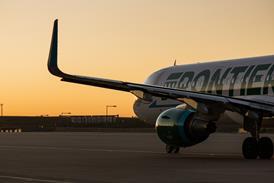
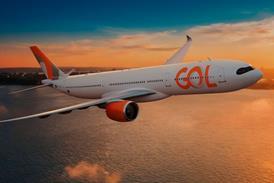











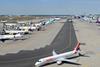

German airline representatives are claiming that point-to-point carriers have not restored their fleets stationed in the country to pre-pandemic levels, and that recovery has stagnated over government-imposed costs.
The German aviation association BDL states that the number of aircraft stationed in Germany by European point-to-point operators is down by 30% – from 190 to 130 – in the six years since 2019, just prior to the onset of the Covid-19 pandemic.
BDL says carriers are “avoiding” Germany and the fleet relocation amounts not only to lost connectivity but also a depletion of the economy.
“Every aircraft stationed in Germany is equivalent to a medium-sized company,” it says, claiming that equates to some 170 jobs and €70 million in gross domestic product contribution.
BDL adds that the situation is also reflected in German airport performance.
Frankfurt airport recorded passenger figures of 61.6 million last year, down 12.7% on 2019, while Munich’s total of 41.6 million was 13.1% lower.
The operator of Frankfurt airport, Fraport, has similarly attributed the weakened recovery to “high state-regulated site costs…namely, air traffic tax”.

BDL says the first six months of this year have not indicated any improvement. It states that the recovery “virtually came to a standstill” over the first half, as a result of the “excessive” costs – while air traffic in other European countries is, on average, “significantly” above pre-pandemic levels.
“We are seeing the consequences at almost every airport in Germany,” says BDL president Jens Bischof. “Airlines are withdrawing their aircraft and deploying them in other European countries with competitive cost levels.
“In view of this alarming development, it is essential that the federal government prioritises the crisis facing Germany as a location for air transport.”
Bischof insists the tax of around €35 ($41) per passenger “must” be halved to alleviate the burden.
“By deciding against urgently-needed relief…the German federal government would be squandering an important opportunity for new economic growth,” he adds.
Analysis from BDL indicates that the annual number of flights between Germany and other European countries, around 1.1 million, is 20% below pre-pandemic levels, while domestic traffic was also “significantly weaker” – just under half of 2019 figures, including feeder flights to Frankfurt and Munich.