













Crash-victim attorneys have appealed a 6 November decision by a US judge to dismiss the Department of Justice’s criminal fraud case against the company.
That judge tossed the case at the DOJ’s request, saying he had no choice despite expressing misgivings.
Filed in the US Court of Appeals for the Fifth Circuit, the appeal says the judge’s decision “failed to protect” public interest. It alleges that the DOJ violated crime victims’ rights by not conferring with them when negotiating deals with Boeing.
“For the sake of maintaining any semblance of genuine public interest scrutiny… this court should reverse,” attorneys say in their 14 November appeal.
Boeing declines to comment.
The case has been working through court for years. The DOJ filed the charges in January 2021, alleging that Boeing defrauded the Federal Aviation Administration during certification of the 737 Max by withholding details about the jet’s Maneuvering Characteristics Augmentation System.
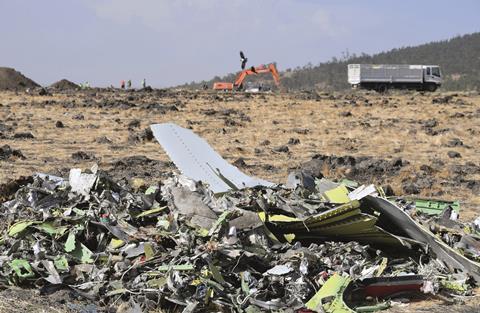
That system was subsequently identified as a factor contributing to the 2018 crash of a Lion Air 737 Max 8 and the 2019 crash of an Ethiopian Airlines Max 8. The accidents killed a combined 346 people.
In May, the DOJ asked Judge Reed O’Connor in Texas to dismiss its case because the government had reached a non-prosecution agreement (NPA) with Boeing.
On 6 November, O’Connor approved the motion, saying he had no authority to overrule the prosecutor. He did so despite writing in his decision that the NPA “fails to secure the necessary accountability to ensure the safety of the flying public”. He said the deal does not subject Boeing to a truly independent compliance monitor.
Some relatives of crash victims supported the NPA. Others challenged it.
In their appeal, attorneys urge the court to reinstate the case, saying judges can indeed overrule prosecutors in such matters if doing so upholds the public interest.
The attorneys also allege crash victims’ rights were violated because the government failed to confer with relatives when negotiating deals with Boeing, including a 2021 deferred prosecution agreement (DPA).
Boeing initially sidestepped prosecution by signing that DPA, under which it agreed to pay a $243.6 million criminal penalty, $1.77 billion in compensation to airlines and $500 million to victims’ beneficiaries.
But in 2024 the DOJ tore up the DPA after a Boeing manufacturing defect caused the in-flight failure of a 737 Max 9’s mid-cabin door-plug.
Boeing then pleaded guilty under a settlement agreement that would have subjected it to an “independent compliance monitor”. But in December 2024, judge O’Connor threw out that deal, citing concerns related to the monitoring.
As a result, Boeing was set to go to trial, until the DOJ revealed the NPA and sought the case’s dismissal.