















L3Harris is using the third biennial World Defense Show (WDS) to underscore its decades-old presence in Saudi Arabia, as work continues to upgrade Riyadh’s most sophisticated airborne intelligence, surveillance and reconnaissance (ISR) capability.

“Our partnership here is deep-rooted in ISR,” Craig O’Donnell, director, international business development, advanced solutions group, told FlightGlobal at the event near the Saudi capital on 10 February. “For over three decades we have been supporting an ISR platform in-kingdom,” he adds.

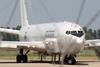
The aircraft in question is the RE-3A: a heavily adapted Boeing 707 which serves in the multi-intelligence-gathering role, and is increasingly akin to the RC-135V/W Rivet Joint assets operated jointly by the US Air Force and UK Royal Air Force.

RE-3A Saudi

Source: Carlos Menendez/Wikimedia Commons

Library image of the Royal Saudi Air Force’s lone RE-3A surveillance aircraft

“They are the only three elite nations that operate a widebody strategic collection platform,” O’Donnell says.

The broad range of equipment installed on the platforms gives operators “the ability to sense, make sense and act against the adversary”, he adds.

And Saudi Arabia’s lone RE-3A is currently getting smarter.

“Last year we signed a contract with the Royal Saudi Air Force [RSAF] to give their platform the latest upgrade, which it is now undergoing. It will be fitted with a significantly enhanced collection suite, communication suite and a full avionics upgrade, to keep it relevant against modern threats,” he says.

In late 2023, the US Defense Security Cooperation Agency (DSCA) outlined a potential upgrade deal for the RSAF aircraft, valuing the Foreign Military Sales deal at an estimated $580 million.

At that time, the DSCA said the activity would “improve Saudi Arabia’s surveillance capability to counter current and future regional threats, strengthen its homeland defence, and improve interoperability with systems operated by US forces and other Gulf Region partners”.

Meanwhile, the US company’s exhibit at the 8-12 February WDS event features a scale model of its business jet-based airborne early warning and control (AEW&C) system.

Available either on a Bombardier Global 6500 (Aeris X) or Gulfstream G550 (Aeris A), this offers 360° surveillance coverage through the use of nose-, tail- and fuselage side-mounted arrays.

“That is a huge advantage, as it doesn’t compromise the aircraft performance – it can climb and manoeuvre and remain survivable,” O’Donnell says.

Additionally, L3Harris is touting the AEW&C capability as having been “designed from the outset for fifth-generation [fighter aircraft] interoperability”.