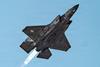

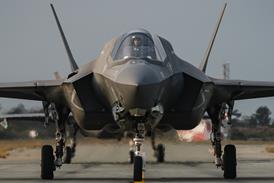












Lockheed Martin will spend more of its own money this year to improve the delivery of sustainment services and boost operational readiness rates on the F-35 fighter, the US airframer’s chief executive says.
“Over a fair few prior years there was – in our opinion – some under-funding of spare parts and repair capacity,” CEO James Taiclet says.
“We have been striving to make up for some of that with internal investment,” he notes. “We have put a billion-plus [dollars] into spare parts and repairs already, but we are going to double-down on that, to make an extra effort to improve the mission-capable rate for the aircraft and make up for the unfortunate deficit that’s been created over the last four or five years.”

Speaking during the company’s annual results call with analysts on 29 January, Taiclet noted: “It does require investment, but we feel that we are going to get benefit both financially and operationally out of the performance of the aircraft.”
To value $1 billion, its renewed commitment will “improve mission-capable rates across the fleet”, he says. “This is an absolute priority, and one we are working closely with the [US] Department of War on.”
Additionally, “In 2026 we will make further investments in the programme… with a focus on making further progress on Block 4 capability improvements,” Taiclet says.
After delivering a record 191 F-35s last year – including examples which had been placed into storage pending delayed approval of a Technical Refresh 3 package of updates – Lockheed expects to hand over a reduced total of the fifth-generation fighters in 2026.
“We expect deliveries to be in line with the production rate this year,” says chief financial officer Evan Scott, with its annual output “holding steady” at 156 jets.
Lockheed also will make a further $1 billion investment towards preparing for future Block 4 capability updates to the F-35.
In all, the airframer secured contracts worth $15 billion against the F-35 programme in 2025, Taiclet says. That figure includes definitised deals for Lot 18 and 19 of production, sustainment agreements, and also amended commitments for work in lots 20 and 21.
Taiclet also touched on the classified aeronautics development project against which Lockheed announced a $950 million penalty charge in the second quarter of 2025.
“This is a very complex design and integration activity, and risks are going to remain over the next few years as we progress through more key phases of the programme – which is progressing well,” he says.
“Notably, there were no additional charges reported on this programme in the fourth quarter. We continue to proactively monitor and manage potential risk, with our highest level of executives personally involved,” he adds.
“We are very confident in it [the programme], and in the team we have on the field to execute it.”
Lockheed also is already spending its own funds to advance work on a Collaborative Combat Aircraft (CCA) design.
“We are building our own prototype of the drone wingman, or CCA – on our own R&D budget – because we think we will have the best product and we will get the scale of orders [needed],” Taiclet says.
The company in September 2025 revealed work by its Skunk Works unit on a platform named Vectis, which it said will “seamlessly integrate” with fifth-generation platforms such as the F-35.
Lockheed missed out on the US Air Force’s first-increment CCA opportunity, which will be met by either Anduril Industries or General Atomics Aeronautical Systems, with a selection decision expected late this year. Along with multiple other US companies, Lockheed is eyeing the service’s follow-on requirements to field uncrewed fighters, along with a similar need from the US Navy.
Lockheed recorded sales of $75 billion in 2025, with an operating profit of $6.7 billion. It also saw the value of its order backlog rise for the fourth successive year, to sit at $194 billion at year-end.