











The UK Royal Navy (RN) plans additional operational testing and development of uncrewed systems in the coming years, including its Peregrine and Proteus platforms, as it works towards fielding a hybrid air wing that blends unmanned assets with crewed aircraft.
However, although there is an immediate focus on uncrewed activities, the service remains committed to the development of a future manned rotorcraft to arrive in the 2040s.

First detailed in its 2024 Maritime Aviation Transformation Strategy (MATX) and reinforced by the UK government’s Strategic Defence Review last year, the RN is seeking to move to a model of “uncrewed where possible, crewed where necessary”.
Speaking at IQPC’s International Military Helicopter conference under Chatham House rules on 24 February, a senior official said all the service’s key “capability outputs” – sense, decide, effect, connect, host, enable – “have the potential to be delivered by an air system”.
Development of uncrewed capabilities to support those outputs, and the underlying operational procedures, will continue, the official says, building on previous test and evaluation activities.
As well as trials carried out at the service’s RNAS Culdrose and Yeovilton bases, this effort has seen elements of the RN’s 700X Sqn deployed to demonstrate the capabilities of uncrewed systems while at sea.
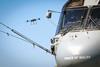
This has included use of the Malloy Aeronautics T-150 cargo drone during a recent Carrier Strike Group (CSG) deployment, the official says.
Despite the inherent challenges of “integrating uncrewed aircraft” into the “congested” deck environment and airspace around a carrier task group “the 700X crews were able to demonstrate ship-to-ship and ship-to-shore resupply”.
Describing the activity as “modest yet trailblazing”, the official says it “clearly demonstrates the efficacy of using relatively simple drones to move stores instead of using a three-engined Merlin helicopter”.
The same logistics resupply exercise will be repeated during the next CSG deployment so that the RN can “continue to learn by doing”, they add.
Similarly, the service will build on the lessons learned from operating the Thales Peregrine UAS – based on the Schiebel Camcopter S-100 – from HMS Lancaster in the Red Sea.
That saw sensor data from the intelligence, surveillance and reconnaissance asset integrated with the Type 23 frigate’s combat system.
Although not without challenges, there were “well-reported successes”, including narcotics-interdiction missions, the official notes.
As a next step, the navy will “develop a standalone containerised” version of the Peregrine, allowing its “embarkation from smaller ships”.
Through this, the RN “will forgo the benefits of integration into a complex warship to scale-up the deployment of aviation capability in ships that do not normally embark aircraft”, including Royal Fleet Auxiliary assets or offshore patrol vessels (OPVs), the official says.
“Take something like an OPV – put a containerised solution on it, and it turns into a corvette overnight,” they say.

Development of the autonomous technologies matured through the Leonardo Helicopters Proteus demonstrator programme will also continue, the official adds.
Calling it a “key step on the journey” towards developing future platforms to take on missions such as anti-submarine warfare and wide-area surveillance, they say the RN will “invest in elements” of the programme, particularly the “autonomous behaviour” – described as Proteus’s “secret sauce”.
“And then hopefully what we are going to be in a position to do, ultimately, is to bridge to what comes next quite quickly.
“We will use Proteus for as long as we can and we should use Proteus to develop the things that are of value to us… and then we need to pivot to what will be a prototype for a production aircraft as early as we are able to.
“If we can get out of active [sonar] dipping as a crewed sport and do this as an autonomous effect, then we are really into game-changing territory.”
However, the scale and speed of any future development activity will hinge on the amount of funding allocated in the government’s long-awaited Defence Investment Plan.
In future, the RN will adopt a “platform-agnostic approach”, the official says, that “removes any lingering tendency to think of capability development in terms of successionist equipment – Sea King replaced by Merlin, Lynx replaced by Wildcat”.
Instead, aviation’s “inherent attributes of high speed and reach” offer a “compelling opportunity to host new capabilities”.
Even if there is an immediate focus on the development of uncrewed capabilities, the RN is not moving away entirely from crewed helicopters.
The official says there will be the need from around 2040 onwards for a new manned platform the service refers to as FCMAS – or future crewed maritime air system – to replace its current Leonardo Helicopters Wildcat and AW101 Merlin assets.
Such rotorcraft will be required to move troops and for “complex warfighting”, the offical says, noting: “These are human points of delivery.
“But FCMAS is a system, so it doesn’t constrain itself to a single helicopter type to do literally everything with one aircraft.”