













The Pentagon’s secretive technology research arm is ending a project to develop a heavy-lift amphibian aircraft.
After three years or research and development, the US Defense Advanced Research Projects Agency (DARPA) says it is concluding the Liberty Lifter project without plans to construct a flight-capable demonstrator.
“We’ve learned we can build a flying boat capable of take-off and landing in high sea states; the physics make sense,” says Christopher Kent, programme manager for the Liberty Lifter project.
DARPA launched Liberty Lifter in 2022 with the goal of producing an aircraft capable of carrying heavy, large-volume loads and of taking off and landing on water without ground or ship-based infrastructure.
The goal of the project was to find a way of combining the payload efficiency of sealift with the flexibility and speed of air transport.

DARPA tells FlightGlobal it was able to validate the Liberty Lifter concept using simulations and materials testing. Rather than funding construction of a demonstrator aircraft, the agency says it is instead sharing its findings with industry and the Pentagon, in the hope it will be adopted more quickly.
Such an outcome is not uncommon for a DARPA programme. Although the agency does fund the fabrication of operational demonstrators, its primary goal is to sufficiently mature emerging technologies and concepts to the point they become attractive to the US military services.
That point was apparently reached on the amphibian transport concept without needing to build a flight-capable prototype.
“We think our findings validate the hypothesis we had going in: you can build platforms that fly significantly cheaper and at significantly more locations than we do today,” Kent says. “This opens up a pathway for next-generation aircraft to be built using far more efficient construction technologies.”
Specifically, he notes that maritime building techniques and maritime composite materials have been proven as viable for a modern flying boat.
Any further development of the concept will require the formulation of an industrial framework for synchronising maritime construction with the aircraft certification process.
Longer term, DARPA believes findings from the Liberty Lifter research could help reduce the cost-per-kilo of assembling large military and commercial airframes by a factor of 50%.
The lone remaining entrant in the flying boat project – Aurora Flight Sciences – says it expects to apply the discoveries gleaned via its Liberty Lifter development to unspecified future programmes.
A subsidiary of Boeing, Aurora was the final contender for the Liberty Lifter after DARPA announced that uncrewed aircraft developer General Atomics Aeronautical Systems had been dropped from the programme in 2024.
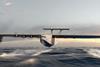
Concept sketches of Aurora’s design depict a mono-hull, high-wing airframe powered by eight turboprops.
Renderings of the proposed General Atomics concept show a twin-hull configuration with a mid-wing and an even larger number of pusher propellers.