














India’s challenging geopolitical situation and brief conflict with Pakistan in early May add urgency to New Delhi’s seemingly endless quest to induct new fighters.

The country’s chief strategic rival, China, has made impressive airpower strides over the last 15 years in fifth-generation fighter technology. It has added the Chengdu J-20 in large numbers, developed the smaller AVIC/Shenyang J-35 for aircraft carrier operations, and the J-35A is entering service with the People’s Liberation Army Air Force.

Beijing also continues advancing sensors and weapons capabilities of fourth-generation types such as the Chengdu J-10, and Shenyang J-11, J-15, and J-16, while improving pilot training.

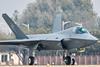
Avic J-31A

Source: Chinese social media

The J-35A: coming to the skies of Pakistan

China has already progressed to flying prototypes of what appear to be sixth-generation jets, alongside new unmanned combat aircraft.

India, meanwhile, has struggled to boost its fighter strength. With the coming retirement of the Mikoyan MiG-21, the Indian air force will fall to just 29 combat squadrons, whereas it has long said that it requires 42 squadrons to handle a two-front war with China and Pakistan.

While there is debate in Indian defence circles about whether advances in aircraft capabilities mean fewer squadrons are necessary, India’s need for modern aircraft is growing ever more pressing.

Over the last decade, India has added just 36 Dassault Aviation Rafales acquired after the 2015 cancellation of the Medium Multi-Role Aircraft Competition (MMRCA). It has also inducted 36 of the long-delayed Hindustan Aeronautics (HAL) Tejas Light Combat Aircraft Mk1, a relatively limited fighter. The more capable Mk1A is only due later this year, while the advanced Tejas Mk2 is set to arrive in large numbers only in the 2030s, replacing obsolescent Sepecat Jaguars and Dassault Mirage 2000s.

A major upgrade for 84 of India’s Sukhoi Su-30MKIs is also underway, with Hindustan Aeronautics (HAL) modernising the type’s avionics, sensors, and electronic warfare capabilities. December 2024 also saw HAL win a contract for 12 new-build Su-30MKIs, but since production ceased at Nashik in 2019, it will take 18 months to two years to restart.

New Delhi’s proposed fifth-generation fighter, the Advanced Medium Combat Aircraft (AMCA), remains in its very early stages – at least a decade behind Chinese advances. Officially to be ready for service by 2032, given India’s long struggles with the Tejas this timeframe could be overly optimistic.

Indian AMCA Programme Moves Ahead 1

Source: Aeronautical Development Agency

AMCA is years away from entering service

Adding pressure is Beijing’s intention to furnish the J-35 – likely the ‘A’ variant – to Pakistan. In early June, Pakistan’s Prime Minister Shehbaz Sharif said Islamabad had received an offer for 40 J-35s, as well as an unspecified number of Shaanxi KJ-500 airborne early warning and control (AEW&C) aircraft.

While clearly escalatory and irritating to a key BRICS partner, Beijing likely sees clear strategic benefits, particularly given New Delhi’s relationship with the USA. Though both democracies, the USA and India are not allies – indeed, US President Donald Trump recently raised India’s hackles with talk of 25% tariffs over Indian purchases of Russian oil.

Beijing may regard the India-USA relationship as a significant strategic threat, creating potential for a second front should hostilities break out over Taiwan. India could offer allied aircraft – such as American bombers based at Diego Garcia – a backdoor for strikes against Mainland China.

Boosting Pakistani airpower, alongside improving bases in Tibet, would impose deterrence on New Delhi. While J-35 and KJ-500 sales would annoy India, Chinese President Xi Jinping likely sees this as manageable if it supports his ultimate goal of uniting Taiwan with the Mainland.

A Pakistan J-35A sale represents a natural next step in China-Pakistan cooperation. Beyond selling it the J-10C, China helped develop the Chengdu/Pakistan Aeronautical Complex JF-17, now flown in a Block III configuration with a Chinese AESA radar and PL-15 air-to-air missile capability.

The importance of Chinese aid was displayed in early May, when Pakistani J-10C fighters reportedly shot down Indian aircraft with long-range PL-15 missiles. While details about the 7 May air battle remain murky, Pakistan apparently deployed an effective kill-chain against Indian aircraft, downing up to five aircraft, including at least one – and possibly three – Rafales.

Pakistani AEW&C aircraft – specifically Erieye radar-equipped Saab 2000s – apparently generated target tracks for J-10Cs, which launched PL-15s while operating with fire control radars in passive mode, helping hide their presence. Pakistan has also touted its electronic warfare prowess.

PAF J-10B

Source: Pakistani air force

Pakistan’s J-10Cs have proven effective at using the PL-15 as part of a networked kill chain

Rationales for the Indian air force’s early performance have since swirled. Some reports suggest intelligence failures about the PL-15’s capability, while others point to restrictive rules of engagement precluding use of MBDA Meteor beyond-visual-range air-to-air missiles carried by the Rafales.

Despite early setbacks, the Indian air force gained vindication in subsequent days, losing no aircraft while striking deep into Pakistan and thwarting Chinese-designed air defences. The indigenously designed Brahmos supersonic cruise missile proved particularly effective.

Still, the episode demonstrated the power of Pakistan’s air force potency and the capabilities of Chinese aircraft and weapons, particularly as networked assets. With fifth-generation aircraft these capabilities will only improve, creating an urgent need for India to incorporate new aircraft.

Unfortunately, New Delhi’s opportunities to obtain fifth-generation aircraft in the near term appear extremely limited. Though President Trump offered India the F-35 in February, Indian media reports suggest this has been quietly rejected.

The deal always looked like a non-starter given technical hurdles including incompatible systems, US export controls, and entirely new maintenance infrastructure requirements. India’s diverse fleet, including a reliance on Russian platforms, and operational sovereignty demands would further complicate F-35 adoption.

Although Trump seemed willing enough to sell F-35s to India, future administrations may have balked at the prospect. Turkey’s experience offers a cautionary tale. Ankara’s acquisition of Russia’s S-400 surface-to-air missile (SAM) system saw Washington kick it out of the F-35 programme. The US feared the Russian system would expose F-35 vulnerabilities through radar tracking and electronic surveillance. India operates the S-400 and a range of other Russian SAM systems.

New Delhi has also reportedly rejected Russian Su-57 offers. The platform remains largely unproven, with limited production and poor performance during the war in Ukraine, while any major acquisition would provoke US displeasure.

The Global Combat Air Programme involving Italy, Japan and the UK, and Europe’s Future Combat Air System activity between France, Germany and Spain are respectively 10 and 15 years away from planned service entry, meanwhile, and at even earlier development stages than India’s AMCA.

Indian air force Rafales

Source: Indian air force

Prior to the recent clash with Pakistan India operated 36 Rafales

As its lack of fifth-generation jets grows increasingly glaring, New Delhi has yet to seriously advance its Multi-Role Fighter Aircraft (MRFA) competition, the successor to its axed MMRCA programme. Contenders include the Rafale, Boeing F-15EX, Eurofighter Typhoon, Lockheed F-21 (a rebadged F-16V), and Saab Gripen E/F.

While not fifth-generation platforms, these capable and mature jets offer advanced datalinks, sensors and weapons. Large-scale introduction would advance Indian airpower and help mitigate the fifth-generation shortfall. Indeed, in early 2025 the US Air Force found the F-15EX “operationally effective” even against fifth-generation aircraft.

Prioritising MRFA, picking a winner, and staying the course would seem the best way to add advanced capabilities while hedging against Chinese and Pakistani airpower developments. MRFA contenders have emphasised willingness to build aircraft in India, meeting key Indian political objectives.

Years of bureaucratic inertia and changing requirements have created a clear capability gap between the Indian air force and its primary rivals. Still, Indian pilots showed professionalism and resilience in May, rallying from early losses to deal effective blows against Pakistan.

Despite the Indian air force’s clear strengths, increasingly advanced types on the nation’s frontiers make the induction of new combat aircraft an even greater priority. Pursuing AMCA makes sense, but in the interim New Delhi needs rapid decisions on new types that can hold their own against the best that China and Pakistan can field.