











Elected legislators in the US Congress are urging Boeing to reach a labour agreement with 3,200 striking workers at the company’s fighter aircraft production hub.

A bipartisan letter signed by 16 members of the House Armed Services Committee (HASC) on 28 October and sent to Boeing chief executive Kelly Ortberg calls on the company and the International Association of Machinists and Aerospace Workers (IAM) labour union to return to negotiations and end the strike.

The call from Washington comes just days after the members of the machinist union narrowly voted down Boeing’s latest contract offer, with 51% of members rejecting the contract terms in a 26 October referendum.

“While we understand that there currently are no new negotiations scheduled between IAM District 837 and Boeing Defense, we are urging both sides to come back to the table to negotiate to conclude this ongoing, disruptive strike,” the lawmakers say.

f-15ex-build-c-boeing

Source: Boeing

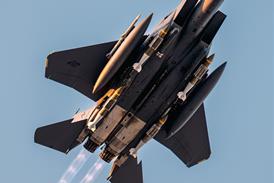
Boeing has delivered half of the 12 aircraft planned for F-15EX production Lot 2. However, the pace of assembly work has been slowed by the strike, delaying the remaining shipments

Assembly line workers at the St. Louis, Missouri fighter production campus have now been on strike for more than 12 weeks. Union members have turned down repeated contract offers from Boeing, demanding more pay and larger signing bonuses.

While the work stoppage has not fully halted production of Boeing’s tactical jets, which include the F-15EX, F/A-18E/F, T-7A and MQ-25, output has been impacted.

Intervention by a federal government mediator has failed to resolve the standoff, which has frequently devolved into a public war of words between the two sides.

jdam-er

Source: Royal Australian Air Force

Boeing has managed to maintain production of JDAM kits, which convert unguided gravity bombs into precision GPS-guided munitions

Invoking US national security, signatories of the HASC letter are now calling on Boeing to “bargain in good faith to reach a fair contract in a timely manner”, describing both Boeing and its workforce as “vital” to American defence and security.

“These workers are essential to the success of your company, and they deserve compensation that reflects their hard work and sacrifices,” write members of Congress. 

Although Boeing has made concessions throughout the protracted strike, the company has repeatedly taken a hard line on the contract terms, while accusing the union of failing to lay out clear goals and targets for a deal.

Ortberg only briefly mentioned the labour disruption during his 29 October quarterly earnings call with investors, noting that output on product lines like the Joint Direct Attack Munition (JDAM) guided bomb kit is not being affected.

“We are building JDAMs without IAM workforce at about the same production rate as before the work stoppage, and the team is progressing on our MQ-25 and T-7A development programmes,” Ortberg says.

In early September, roughly one month after the strike began, Boeing declared it would begin hiring permanent replacements for the striking IAM staff and began reassigning non-union personnel with similar skills to at least partially maintain production on key defence articles.

However, in testimony provided to Congress earlier this month, US Air Force (USAF) chief of staff nominee General Kenneth Wilsbach confirmed that F-15EX deliveries are being impacted by the strike.

“Lot 2 aircraft, initially expected to deliver this calendar year, are delayed due to the ongoing Boeing strikes with six of 12 F-15EXs delivered to date,” said Wilsbach, who previously headed the USAF’s fighter command.

Those delays will impact the initial fielding of the modernised F-15 to the first overseas operator – a USAF fighter squadron permanently based in Japan.

“While later than initially planned, aircraft deliveries and programme milestone dates remain within the programme’s acquisition baseline,” Wilsbach added.

The day before Ortberg spoke to investors, the chief executive of Boeing Defense, Space & Security (BDS), Steve Parker, categorically rejected any notion that the company has not sought a compromise, describing the proposed contract as “more than fair”.

“From the start, we negotiated in good faith and put our best offer on the table at the end of July,” Parker wrote in a 28 October letter to all BDS employees that was shared with FlightGlobal.

“Since then, our teammates provided feedback and we adjusted our offer accordingly. This process has been fair and respectful to our people,” he adds.

Parker lays blame for the continued impasse squarely with the union, claiming that the IAM is setting “unrealistic expectations” for its striking members.

“Just yesterday, they asked for more money after we’ve repeatedly said more is not coming,” the BDS chief says.

Boeing will accelerate efforts to hire permanent replacements, Parker says, which may see some of the IAM workers be “displaced”. The airframer also says it is expanding the use of “third-party support” for certain jobs, without providing specifics.

F-15EX arrives in Portland c USAF 142d Air Wing

Source: US Air Force

Boeing has thus far delivered eight operationally configured F-15EX fighters and five test aircraft. However, the ongoing labour strike is delaying an additional six frontline examples on order and plans to subsequently field the jet to a forward deployed squadron in Japan

Reacting to the comments from senior Boeing leadership, IAM International president Brian Bryant on 29 October dismissed the company’s efforts to hire replacement workers as “failing because they can’t replace the skill, precision, and experience of IAM union members”.

“The company hasn’t delivered a single new F-15 during this 13-week strike, and production delays are now rippling into the 777X programme,” Bryant says.

During his 29 October call with investors, Ortberg acknowledged new delays to the 777X certification effort, which have generated a sizeable $4.9 billion charge for Boeing, partially tied to customer penalties.

Now the first of those aircraft, which is one of the few Boeing commercial projects based at the St. Louis hub, is not expected to be delivered until 2027. The 777X charge drove Boeing to post a $5.3 billion loss for the third-quarter.

Union boss Bryant also rejects any notion that the IAM is to blame for the deadlock with management, saying “the IAM union continues to bargain in good faith”. 

Boeing officials have previously told FlightGlobal that IAM members are seeking a compensation package on par with the terms offered to commercial aircraft machinists in the greater Seattle area, who went on strike for two months in 2024.

That unit numbered more than 30,000 workers, who at the time had not renegotiated a contract in roughly a decade. They also forced Boeing to shutter several of its most important commercial aircraft assembly lines, which are the company’s financial lifeblood.

A Boeing official tells FlightGlobal that management does not support a similar compensation increase for the fighter assembly workers, whose previous labour agreement was negotiated in 2022.

Defence customers also have significantly more flexibility than commercial operators when it comes to receiving new aircraft.

Additionally, all of the jets impacted by the strike are either in the early stages of low-rate production (the F-15EX), engineering and manufacturing development (T-7A and MQ-25) or are legacy models winding down production (F/A-18E/F), lessening pressure to resume normal work rates.