













We have all become used to the phrase “There’s an app for that” – an Apple campaign slogan when it launched the iPhone. But sometimes an overload of applications on our mobile devices can leave us confused or frustrated as we scroll and search for the right icon.
The same applies to aviation. Electronic Flight Bags (EFBs) were the cockpit equivalent of the smart phone or tablet, revolutionizing how pilots accessed vital manuals and charts when they began replacing paper-stuffed flight bags around two decades ago.
EFBs meant aviators no longer had to haul around 50lb (23kg) briefcases of information while their operations departments moved on from the cumbersome task of manually filing revisions and reprinting countless documents. They led to a massive improvement in a pilot’s working routine and quality of life.
However, as the years and technology advanced, more pieces of software appeared on the market as almost every aspect of a pilot’s working life went electronic – from flight preparation and navigational charts to checklists to deal with a range of in-flight situations.
The result is that aviators can face app fatigue, suggests Jeff Herron, Integrated Product Team Lead at Jeppesen ForeFlight, which has been helping pilots navigate since 1930, and was a pioneer of EFBs.
“As more apps have been released, pilots have more tools than ever to help them do their job, but the industry has grown saturated with too many apps,” he says. “Sometimes pilots are dealing with upwards of 10 apps on their EFB.”
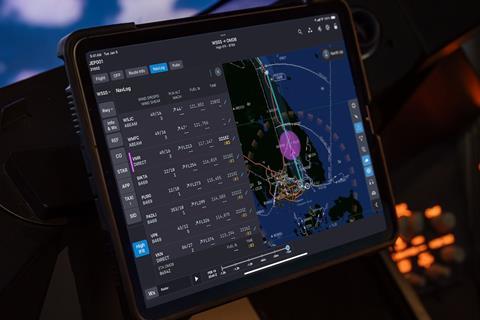
Jeppesen’s newest solution is its fully Integrated EFB, centered on FliteDeck Pro, the industry’s most used navigation app. The latest 5.1 version combines the navigation tools Jeppesen is famous for with the addition of electronic flight briefing, navigation logging, and fuel saving workflows.
Jeppesen describes the latest iteration as the industry’s first truly integrated EFB – not just a series of apps connected by interfaces, but a seamless integrated experience that allows pilots to quickly move between tasks without losing situational awareness or context.
“A lot of companies out there hang their hat on being ‘integrated’,” says Herron. “But what they usually mean is that the apps are interfaced with information shared from one app to another. What we have done is really consolidated everything onto a single platform.”
When it came to designing the app, Jeppesen drew on its many decades of experience combined with feedback from their customer advisory board to really understand what pilots and their operations departments wanted.
“Where we stand out is the amount of time we invest on the design aspect,” says Herron. “Our design team spends the majority of their time with our customers, fine tuning a workflow and then testing it with our customers in their simulators to ensure it is as intuitive as possible. It’s a constant cycle.”
He adds: “It is all about reducing complexity. The biggest cost for an airline, after fuel, is manpower. So, if pilots are stuck in a training room learning how to work a piece of software, then we’ve failed in our job.”
That time-saving aspect is why the Integrated EFB is particularly useful for smaller operators with fleets of up to 20 tails, who often lack the resources to manage multiple revisions across a range of applications. “By reducing the number of apps, you reduce the management time involved in updating,” says Herron.
“Not only do pilot workflows improve, but you create a better flow of information between flight deck, dispatch, and back office to improve efficiencies across your flight operations,” he adds.
Another benefit of the latest version of FliteDeck Pro is that not all aspects have to be deployed at once. “Capabilities can be turned on when an operator is ready. They can scale with our solution,” says Herron. “They have control over what is switched on or switched off.”
The product is another example of Jeppesen ForeFlight’s mission to improve the job satisfaction of its customers. It saves time and money by reducing workloads and headaches for flight crews and operations departments, but most importantly improves safety, ensuring pilots can access the information they need at a moment’s notice, especially in those circumstances where seconds really matter.