















Inspections of main rotor components returned to Airbus Helicopters in the wake of a 2 January ditching of an H160 medium-twin off the Brazilian coast have so far found zero defects, the airframer has revealed.

Company executives, including programme head Benoit Klein and H160 chief engineer Benoit Gresle, disclosed the findings – approved for release by Brazilian air accident investigation agency CENIPA – during a joint industry presentation alongside the operator of the incident helicopter, Omni Taxi Aereo, on 10 February.

It further reinforces the impression that CENIPA is now mainly focused on a maintenance issue in the days prior to the ditching, rather than any underlying mechanical problem with the aircraft.

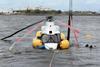
H160 ditching third-c-CENIPA

Source: CENIPA

All eight occupants safely exited the helicopter following the ditching

All eight occupants aboard the H160 (PR-OFB) escaped safely after the crew opted to ditch after encountering “significant vibrations” around 20min into an otherwise uneventful flight from Cabo Frio to an offshore platform.

CENIPA subsequently traced the vibrations to the fatigue fracture of a pitch-control rod attached to one of the five main rotor blades.

In the immediate aftermath of the incident, Airbus Helicopters and the European Union Aviation Safety Agency mandated the replacement of pitch-control rod-end bearings on all H160s before they reach 165 flight hours.

Parts removed during the process were to be sent to the airframer for further investigation. Of the 26 sets of rod-end bearings removed, 15 were returned to Airbus Helicopters, with five of these received for inspection, recording “no findings”, the document states.

Indeed, Airbus Helicopters is now planning to withdraw the emergency alert service bulletin (EASB) and associated airworthiness directive mandating the 165h removals, Klein confirmed to journalists during a 17 February H160 programme update.

This will take up to three weeks, he says, as the airframer liaises with the authorities in Brazil and Europe and carries out some “double-checks”.

Inspection of the H160 by CENIPA showed the fracture in the control rod had initiated from part of the component that was bent to an angle of around 2.5°, what it referred to as “permanent plastic deformation”.

Although fatigue failure of the part could have many causes, including a design issue or underlying material weakness, CENIPA on 5 February updated its preliminary report into the ditching, detailing a maintenance incident on 24 December.

Based on CCTV footage from a maintenance hangar, CENIPA said it believes one of the pitch-control rods had come into sustained contact with part of the airframe during testing of the main rotor.

This left the “pitch rod bent under permanent deformation”, the presentation states.

However, CENIPA has so far been unable to say definitively whether the rod identified on the footage was the part that failed in flight.

H160 Aus-c-Airbus Helicopters

Source: Airbus Helicopters

Highlights last year included a demonstration tour of Australia

A separate EASB covering the inspection of the 10 pitch rod ends on each helicopter for permanent plastic deformation has also thrown up no findings among the 49 sets examined, representing 80% of the fleet.

While emphasising the ongoing nature of the investigation, when asked during the programme briefing whether the probe was now focused on maintenance rather than mechanical issues, Klein offered an unequivocal “yes”.

He says operators of the H160 appreciated “the transparency” shown by Airbus Helicopters and the “speed of reaction”, averting any potential aircraft unavailability issues.

“All the H160s are flying as before, so no change. And the commercial situation is good – the momentum we had in [20]25 is confirmed: in ‘26 we already have two bookings.

“The momentum is there; there is no problem for the customers.”

Indeed, the ditching had threatened to overshadow what Klein describes as a “turning point” for the programme in 2025 during which 30 orders were booked – markedly above the four recorded the previous year – and deliveries ramped up.

Although Airbus Helicopters does not break down its overall delivery total by type, data from the General Aviation Manufacturers Association suggests 29 H160s were handed over during 2025.

Klein says the delivery performance “confirmed the trajectory” of the ramp-up, as the airframer builds towards an eventual annual output later this decade of 40 civil examples plus 20 M-model variant H160Ms.

Development for the H160M Guepard for France is ongoing, with first delivery to the French army due towards the end of 2028.

Klein is also pleased with the operational performance of the H160: average availability of the 65-strong in-service fleet stood at over 90% last year, he notes.

Airbus Helicopters has, meanwhile, will in March extend the time before overhaul for the main gearbox from 900h to 3,000h, based on evidence gathered from the in-service fleet. US certification for the improvement will follow in September.

“After 900 flight hours we [analyse] the gearbox and it is exactly where we expect to be in terms of behaviour and safety, so that’s why we extended to 3,000 [hours] and after we will continue to 6,000[h] to be at the level expected by the market.”

Separately, the manufacturer has increased the maximum payload for H160s fitted with inlet barrier filters – about 40% of the fleet – by 150kg (330lb), or 50kg in single-engine operation.

H160 Derazona-c-Airbus Helicopters

Source: Airbus Helicopters

IBF-equipped H160s will gain a payload increase of up to 150kg based on analysis of in-service fleet