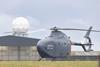














Leonardo Helicopters is uncertain if or when its Proteus uncrewed technology demonstrator will fly again following the autonomous platform’s maiden sortie earlier this year.

In all, the Proteus aircraft achieved barely 15min aloft across two short flights carried out from Predannack airfield in Cornwall in January, effectively ending the four-year, £60 million ($81 million) UK Royal Navy (RN)-backed project’s demonstration phase.

But with the uncrewed helicopter now laid up for planned maintenance, the airframer is in no hurry to see the Proteus airborne again.

Proteus radar-c-Leonardo Helicopters

Source: Leonardo Helicopters

Technology demonstrator is designed to showcase autonomous operation across multiple missions

“At the moment there is no scheduled flight in the roadmap in the next 12 months. But that doesn’t mean we couldn’t do it we were required to, or if we thought there was a need to,” says Adam Wardrope, vice-president market development at Leonardo Helicopters UK.

Wardrope, speaking at a media event at the company’s Yeovil, UK site on 19 February, said the technology demonstration programme “culminated” with the Proteus’s maiden sortie.

However, discussions are now under way with the RN about “the next stage of funding” to allow a follow-on phase: “We are talking to them about what we could achieve, what we can spiral, what further development we can do in the lab.”

Although those negotiations are “reasonably advanced” and Leonardo Helicopters is “relatively optimistic that further funding will come”, much hinges on the government’s serially delayed Defence Investment Plan.

“Like us [the RN is] waiting on what kind of investment they will get to support their ambitions; we are all in the same bag,” says Wardrope.

Additionally, the future of the current platform will hinge on what exactly the RN wants, he notes: “The question will be – do we take the technology that we develop and put it back into [the existing aircraft], retest it, revalidate it, or do we pivot towards something that might look more like the viable product that [we produce] later on?

“We haven’t made those judgements and that will very much depend on how much investment the next phase is, and their ambitions, their goals, and what we can actually deliver in that timeframe.”

In the meantime, Leonardo Helicopters is continuing development of Proteus’s “brain” – the flight-control software and autonomous technology that underpin the concept, he says.

For the current Proteus aircraft, Leonardo Helicopters developed a “completely new” airframe, says programme manager Michael Schunke, while re-using the engine and dynamic components from the company’s existing AW09 light-single to “derisk” the development.

“The fuselage was designed as an uncrewed airframe from the ground up,” he says, avoiding “parasitic weight” through the elimination of any components required for crewed operation.

Proteus 4-c-Dominic Perry FlightGlobal

Source: Dominic Perry/FlightGlobal

All-new fuselage incorporates large modular payload bay

The aircraft’s avionics and sensor suite are contained in the nose bay “and everything behind that is almost empty for payload”, he adds. “That’s one of the true benefits of designing the fuselage from the ground up, you maximise the capacity for payload.”

While payload volume was one consideration, the Proteus can also carry 1t of payload for its 3t maximum take-off weight.

Based on a “basic surveillance fit” – an electro-optical sensor and ADS-B/AIS transponders – in its current guise the Proteus could achieve endurance of around 8h, says Mike Roberts, Proteus marketing manager.

Leonardo Helicopters has modelled over 16 different missions for Proteus, including anti-submarine and anti-surface warfare, wide-area surveillance, airborne early warning, and inter-theatre lift – all to be performed autonomously.

“We have assessed almost all the roles performed by crewed platforms in the navy bar carrying people,” says Roberts.

However, if a production aircraft eventually emerges from the technology demonstration phase, it is likely to be larger than the present iteration, says Wardrope.

“We know the navy wants this platform to operate on a frigate in the North Atlantic on a dark night in sea state six or whatever, so physics dictates it needs to be a certain sort of size,” he says, highlighting the firm’s 6t-class AW159 Wildcat as an example.

“That’s the kind of size I would expect this potentially to be in the future. But of course, it would come down to what exactly they wanted to carry in the payload.”

A larger platform would also likely require a twin-engined powertrain, he adds.

Noting that the pace of future development will be dictated by investment, Wardrope sees the potential to deliver a minimum viable product in the first half of the 2030s, with full operating capability in the 2040s to coincide with the planned out-of-service dates for many of the RN’s manned fleet.

Although a UK-funded programme, Leonardo Helicopters is already seeing interest from international partners – chiefly NATO allies – in Proteus, opening another route to further flights.

“It wouldn’t surprise me in the slightest that if an international partner came along and said: ‘We love what you are doing here, but we’d also like to see if fly please,’ that we wouldn’t go and do that to validate it and assure them this is a real thing,” he adds.

Ultimately, Wardrope remains sanguine on the test asset’s future. Asked if it is essential for it to fly again, he responds: “No, I don’t think so, no. It is here and we have built it so it would be a shame if we didn’t use it. But if you are asking do we need to use it again? No, not necessarily.”

Proteus flies

Source: Leonardo Helicopters

First flight of the Proteus platform was achieved in January this year