













With over 150 flight hours accumulated and weapons testing planned, the unmanned combat aircraft could transform the Royal Australian Air Force’s offensive and defensive capabilities while offering significant range advantages over crewed fighters.

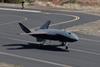
The Boeing MQ-28 Ghost Bat creates a somewhat menacing impression as it taxis toward the runway at Australia’s top secret Woomera test facility. The sharp-nosed unmanned combat jet moves at a rapid pace that appears to belie the human qualities of certainty and purpose.

FlightGlobal was recently among a small group of reporters invited to witness the first public flight of the Australia-designed jet, which has already accumulated over 150h of flight time since its first flight in 2021. The aircraft, then called Airpower Teaming System, was launched at the Avalon air show in 2019. 

Ghost Bat Flight

Source: Commonwealth of Australia

The MQ-28 Ghost Bat makes its first public flying sortie

In the sky the Ghost Bat is sleek and relatively quiet. Its single Williams International FJ44-1A engine has nothing like the growl of bigger – and more expensive – fighter engines. The flight demonstration was basic, with two MQ-28s taking off, conducting a short flight around Woomera’s remote runway, and then landing.

The presence of minister for defence industry Pat Conroy and Royal Australian Air Force (RAAF) chief Air Marshal Stephen Chappell at the MQ-28 flying display underlined the hopes Canberra has for the MQ-28, the first combat aircraft designed in Australia since the Second World War.

According to Boeing Defence Australia and the RAAF, which have co-developed the MQ-28, the aircraft has performed well in testing and completed all milestones four months ahead of schedule.

Work areas have included autonomous behaviours, mission execution, multi-aircraft operations, teaming with a Boeing E-7A Wedgetail airborne early warning and control aircraft, and the fusing of data between “multiple” MQ-28s that was then transmitted to a crewed aircraft.

Chappell’s enthusiasm for the capability the MQ-28 could one day offer the RAAF is clear. He describes MQ-28s positioned, at the ready, along Australia’s vast northern coastline for the defensive counter-air mission. In a crisis, the ability to deploy MQ-28s in a defensive posture would significantly reduce the fatigue imposed on human crews, who would otherwise be required to be on alert.

“You can be sitting in the control station with 20 fighters, all of them MQ-28s, and they’re not getting tired and fatigued just sitting there 24/7,” he says.

“That frees up our crewed force for other missions. You have your defensive piece set, and you have your offensive punches ready, which might be a combination of crewed and uncrewed aircraft.”

Chappell says that large numbers of the relatively inexpensive MQ-28 could help transform the RAAF from a small air force to a medium-sized one.

So far, eight MQ-28 Block Is have been produced, with work underway on three Block II examples. The performance of these updated aircraft will help inform whether Australia moves forward with a Block III version that will feature a larger wing and weapons bays. The Block III, should it be approved, could serve in RAAF squadrons in the coming years.

Chappell explains that the Block II will help realise one of the chief selling points of the Ghost Bat: the ability to swap different modular payloads on and off the nose.

“Block I is literally a prototyping platform, so Block II is taking lessons from that and getting the platform and hardware, cabling and so on, in a way where we can put irreplaceable items on the platform itself, and free up the nose for what it designed to do, which is carry the replaceable payloads.”

RAAF Chief, Boeing Australia Head, Pat Conroy

Source: Commonwealth of Australia

Australian air force chief Chappell discusses the future of airpower, along with Boeing Australia head Amy List and defence industry chief Pat Conroy

He adds that both infrared and radio frequency payloads have been tested on the existing prototypes. Boeing has previously said that unlike Block I aircraft, the Block II will be an operational test asset.

Should the Block III aircraft come into being, it will be produced at a new facility that Boeing is building in the Wellcamp Aerospace and Defence Precinct to the west of Brisbane.

Another milestone will take place at Woomera later this year or in early 2026, with an MQ-28 firing a Raytheon AIM-120 Advanced Medium-Range Air-to-Air Missile at a beyond-visual-range aerial target.

Given the absence of weapons bays in the Block I and Block II jets, the missile will be hung from a centre-mounted pylon. The shot will see the MQ-28 cued to the target with data from another platform. Following clearance to attack, the MQ-28 will autonomously engage the target.

Glen Ferguson, who heads the MQ-28 programme at Boeing, says that the test will round out the key requirements set for the aircraft: finding a target, fixing it, tracking it, and targeting it. In other words, the MQ-28 will prove itself capable of filling an important niche in the kill chain of both the RAAF and allied air forces.

This work will help set the stage for the MQ-28’s future, which could see the development of the Block III for operational use. This Block III’s weapons bays will be capable of holding AMRAAMs and other ordnance. Chappell also sees a clear anti-surface role for the Ghost Bat.

While the MQ-28, which is about the size of a Douglas A-4 Skyhawk, resembles a fighter it has clear limitations. Lacking an afterburner its top speed is Mach 0.9, with an operating ceiling of 40,000ft. It can perform manoeuvres up to 4g. Across all these metrics the aircraft is no match for the RAAF’s Lockheed Martin F-35As and Boeing F/A-18E/F Super Hornets.

The lack of raw fighter performance helps keep costs low. As for speed, most combat activities take place at the subsonic. In the event of an emergency manned fighters can egress at full afterburner. The MQ-28 would not be able to keep up, but that is moot: in such a contingency an unmanned, dispensable aircraft is best interposed between the threat and manned assets.

Ghost Bat IR

Source: Commonwealth of Australia

One of the Ghost Bats that participated in the public flying debut is equipped to test an infrared search and track sensor, which is located just above the nose

Moreover, what the MQ-28 might lack in manoeuvrability and power, it more than makes up for this with a proposed range of 1,900nm (3,500km). This greatly exceeds the unrefuelled ranges of the RAAF’s F-35As and Super Hornets. In the context of Australia’s vast geography, the MQ-28’s ability to loiter will be useful. 

Ferguson, formerly a navigator in the now-retired General Dynamics F-111, says Australia’s geography presents a major challenge.

“We have vast spaces we need to scan, so our ability to fly out of a remote airfield and put aircraft up to operate missions across that whole northern part of Australia is probably key,” he says.

The RAAF is also looking at how a force of MQ-28s could be integrated into its ranks. Initially, the unmanned aircraft would probably be part of a standalone unit as employment concepts are explored and fleshed out. Later, the jets could be integrated with existing units. How the aircraft are managed on the ground will also need to be explored.

And though the MQ-28 is not manned, it will require a dedicated human workforce to hone the capability.

Boeing has talked up the possibility of selling the MQ-28 internationally. At the Paris air show in June, Boeing said that it is seeking a partner in Europe. In his remarks at Woomera, Conroy said that exporting the Ghost Bat is a major priority for Canberra. The type does not, however, appear to be in contention for known US Air Force Collaborative Combat Aircraft requirements, although it is designed to be interoperable with US and allied forces.

In any case, the Ghost Bat appears likely to find a home in the RAAF. Australia has already invested over A$1 billion ($659 million) in the effort. Conroy stresses the importance of having a domestic defence production capability.

“We live in an interdependent world, so some things will always be imported,” he says. “But where we can develop sovereign capabilities, we’re committed to doing that. We’re investing in these sovereign capabilities because it’s the right thing for the defence of the nation. We’re doing it because it’s the right thing for Aussie workers, and it’s a very happy day when those two things are in alignment.”