













Systems supplier Honeywell Aerospace is bullish on the prospects for new business in Asia, particularly around future demand for autonomous aviation platforms.

Several of Honeywell’s core product lines are essential to the burgeoning new category of uncrewed tactical jets, including navigation systems, compact fly-by-wire flight controls and propulsion.

“All different flavours of autonomous systems that are being developed and worked on use a lot of our core technology,” says Matt Milas, president of the defence and space unit of Honeywell Aerospace.

That includes jam-resistant guidance systems and alternative navigation options for GPS-denied environments.

CCA rendering c Honeywell

Source: Honeywell

Honeywell sees big potential in Asia for its new line of small engines designed to power the burgeoning category of uncrewed fighter jets known as Collaborative Combat Aircraft

However, the American manufacturer sees propulsion as the area with the most potential. In fact, so much so that Honeywell is launching a new line of lightweight, low-cost engines specifically designed for powering uncrewed fighter aircraft.

“I do think that that’s going to be a major area of opportunity for us,” Milas says.

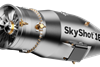
Honeywell has dubbed its new powerplant the SkyShot 1600, also known as the HON1600.

Drawing on Honeywell’s expertise in auxiliary power units, the new line of turbofans will be scalable from 800-2,000lb (3.5-8.9kN)-thrust – a level Milas describes as the “sweet spot” for the uncrewed jets that military operators want at prices substantially below those of conventional fighter aircraft.

The new engine will be significantly smaller than Honeywell’s existing F124 light fighter engine – a 6,300lb-thrust turbofan that powers seven fighter types, including the Leonardo M-346 trainer and light-attack jet.

Honeywell announced plans for the SkyShot in 2025, as the US Air Force began flight testing its two prototype Collaborative Combat Aircraft – the General Atomics YFQ-42A and Anduril Industries YFQ-44A.

Anduril has confirmed that its design is initially being powered by a Williams International FJ44 business jet engine.

“Everybody’s using Williams, FJ44 engines, and nobody can get enough of them,” Milas notes.

That lack of propulsion options for the CCA class has led Honeywell and others to announce plans for new small engines, including Rolls-Royce, Pratt & Whitney, and the team of GE Aerospace and Kratos.

Honeywell is currently ground testing the SkyShot, having mounted the new powerplant on a test stand at the start of the year.

Honeywell SkyShot 1600_2

Source: Honeywell Aerospace

The SkyShot 1600 will offer scalable thrust in the range of 800-2,000lb, a level Honeywell’s Matt Milas describes as the “sweet spot” for the new category of affordable uncrewed fighter jets

Elsewhere, the company is supplying the navigation and guidance systems for the MQ-28 Ghost Bat – the autonomous tactical jet being developed by Boeing and the Royal Australian Air Force.

Milas says Honeywell also sees a strong opportunity in Asia helping national governments build-out their own domestic defence industries. He and his colleagues are spending “quite a bit of time” in Japan and South Korea developing direct commercial sales deals with prime manufacturers in those countries.

That includes supporting major offerings from Korea Aerospace Industries such as the KF-21 fighter, new uncrewed aircraft and guided munitions.

Japan, Milas notes, is home to some of Honeywell’s longest running partners, including Mitsubishi Heavy Industries, Subaru and Kawasaki Heavy Industries – some of whom Honeywell has been supplying for decades.

In Australia, Honeywell is also working under the so-called “Second Pillar” of the trilateral Australia-UK-US security pact to transfer guidance systems and actuation control technology to Australia in support of Canberra’s effort to develop its own industrial capacity for guided munitions.