















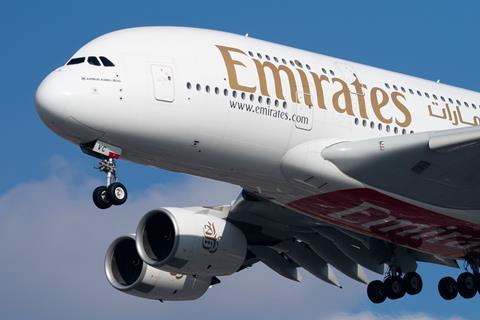
Emirates Group has paid its first corporate tax under a new United Arab Emirates business law, but the change in legislation barely affected its full-year financial performance.
The UAE finance ministry unveiled the 9% corporate tax in January 2022, stating that it would apply to companies whose financial year began on or after 1 June 2023.
It imposed the tax to accelerate development to achieve strategic objectives, says the UAE government, and “reaffirm its commitment” to meet international tax transparency standards and prevent “harmful tax practices”.
Emirates Group’s first financial year under the regulation commenced on 1 April 2024.
“Our teams ran a massive internal programme, establishing clear governance and compliance protocols, which ensured business readiness [for the corporate tax],” the company says.
Its newly-published figures for the full year, which ended on 31 March, show that the group generated a pre-tax profit of Dhs22.75 billion ($6.19 billion) – and that it posted a Dhs20.46 billion profit after taxation, including the UAE corporate payment.
Emirates Airline, the flag-carrier, turned in a pre-tax profit of Dhs21.2 billion – a rise of 20%.
“The airline has delivered this exceptional performance while navigating a new financial terrain,” says the company.
“Despite the introduction of the UAE’s 9% corporate tax this year, the airline not only maintained profitability but substantially increased it.”
Revenues for the airline reached a record Dhs127.9 billion, up 6%, while group revenues rose by the same level to Dhs145.4 billion.
The group also claimed its highest-ever EBITDA of Dhs42.2 billion which, it says, illustrates its “strong operating profitability”.