













Aerospace and defence manufacturers outside the United States are riding high on surging interest in diversifying away from American suppliers.
Driven by the Trump Administration’s abrupt shift away from America’s traditional approach of mutually beneficial alliance building, many defence customers now feel less inclined toward US hardware.
Notably, that appears to be the case both for traditionally staunch US allies and non-aligned middle powers who might previously have viewed arms purchases as a way to secure favour in Washington.
That new reality was on full display at the 2026 Singapore air show, which wraps up on 8 February.
“I’d say there is an uptick,” says Zakir Hamid, head of the Asia-Pacific region for Airbus Space & Defense.
Hamid spoke to FlightGlobal in Singapore as part of a portfolio update on Airbus’ defence efforts in Asia and Europe. He adds that a desire for added supply chain diversity coming off disruptions related to the coronavirus pandemic is also boosting Airbus’ prospects.
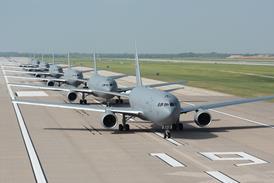
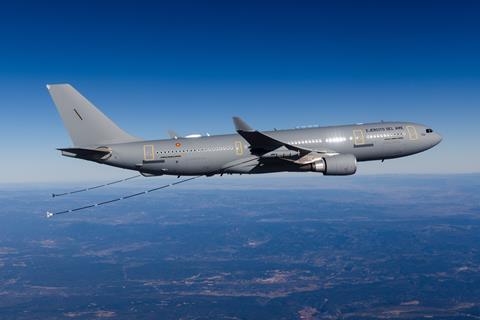
The European airframer is seeing continued success with its mobility platforms, including the A400M transport and A330 Multi-Role Tanker Transport (MRTT).
The latter in particular is seeing strong competitive results in a market long dominated by American rival Boeing.
“We are winning 90% of the campaigns outside the US,” says Maria Angeles Marti, head of tanker and transport programmes for Airbus Defence & Space.
Airbus is also challenging another market segment long dominated by the Americans – maritime patrol aircraft.
Boeing’s P-8A Poseidon has been the uncontested go-to option for maritime patrol in recent years. However, Airbus is moving in on that territory with an MPA platform based on the A321XLR under development for the French navy.
Angeles Marti says that offering is also creating interest in Asia-Pacific region.
In addition to fresh competition on new business, several pre-existing and high-profile deals with American suppliers are now looking shaky or have fallen apart altogether.
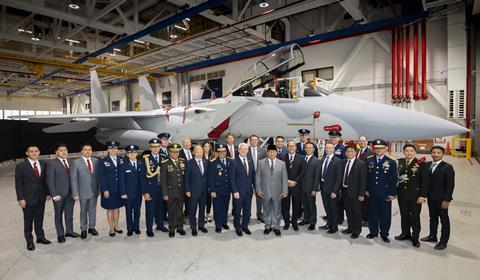
Boeing revealed at the Singapore airshow that talks with Indonesia for the purchase of F-15EX fighter jets have ended, after the company previously signed a memorandum of understanding (MoU) with Jakarta in 2023 covering 24 aircraft.
Bernd Peters, vice-president of business development and strategy for Boeing’s defence unit, described Indonesia as “no longer an active campaign for us”, at the Singapore show.
American defence officials have privately conceded to FlightGlobal that there is a connection between politics in Washington and acquisition decisions made in foreign capitals.
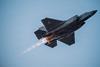
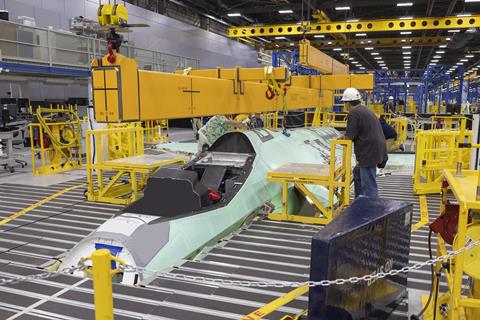
A major deal between Lockheed Martin – another American fighter manufacturer – and Canada for F-35 stealth fighters now appears precarious. Support for Ottawa’s planned buy of 88 jets has cratered in Canada after US President Donald Trump launched a trade war against his northern neighbour.
Swedish fighter manufacturer Saab now stands to gain.
The company has revived its failed bid to provide Gripen E/F fighters to the Royal Canadian Air Force, sweetening the deal with an offer of domestic production in Canada. That proposal also extends to Saab’s GlobalEye airborne early warning and control platform.
Ottawa is currently reviewing its procurement plans, with one likely outcome being a mixed fleet of F-35As and Gripen E/Fs.
Mikael Franzen, Saab’s chief marketing chief marketing officer for Gripen, says the Swedish jet was designed to operate with a high availability rate in a harsh Arctic environment much like Canada.
“The Gripen would give combat mass to Canada, so you could have more aircraft in the air compared to only a single fleet,” Franzen said during a briefing at the Singapore air show.
While the outcome of a sale to Canada remains fluid, what is certain is that Saab logged a banner year in 2025 for Gripen sales and technical milestones.
The Swedish manufacturer signed new sales agreements with Colombia (17 aircraft) and Thailand (4), while continuing deliveries of the latest Gripen E/F too the Swedish air force and launch customer Brazil.
The Brazilian air force (FAB) also logged technical milestones with its aircraft, including successfully test firing an MBDA Meteor beyond-visual-range air-to-air missile.
The first two-seat Gripen F will also be delivered from Saab’s main assembly line in Linkoping in the second quarter of this year.
Saab says it posted a record number of order bookings for 2025 across all its platforms, with the Gripen being a particularly bright spot. Franzen says the company expects to report continued success for the Gripen programme, based on the number of requests for information (RFI) currently active around the world.
“We see a lot of interest in RFIs coming from other countries. So this is a really strong situation for Gripen,” he says.
Those opportunities include active or forthcoming fighter tenders from Portugal, the Philippines, Peru, Austria and an expressed interest from Ukraine in a substantial order of up to 150 Gripens.
Saab’s success is also boosting its regional industrial partners, such as Brazilian airframer Embraer. The company operates a Gripen assembly line in Gavio Peixoto, Sao Paolo state, which is set to deliver its first frontline aircraft to the FAB before the end of this quarter.
Notably, Franzen says the production line in Brazil could be used to support Gripen export sales from elsewhere in the world, not just the order from Brasilia.
Embraer officials have long privately lamented the unequal footing their company faces when competing against American rivals, which previously enjoyed geopolitical tailwinds thanks to the US government’s unique global position.
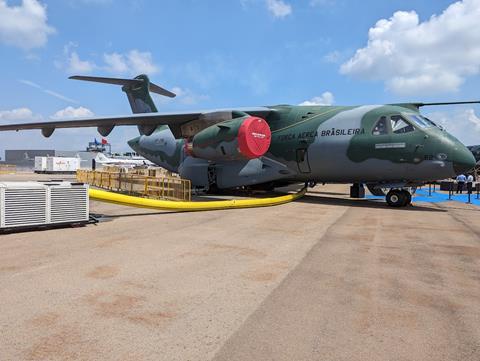
Even in the cordial world of international business, that balance has now shifted subtly, yet decisively. Suppliers like Embraer now feel that their products, such as the C-390 tactical transport, can now compete more purely on merit, rather than geopolitics.
Several Embraer officials who spoke with FlightGlobal at the Singapore air show confirmed they are seeing a shift in the market.
The company underlined this by rolling out South Korea’s first C-390. In 2023, the Embraer type defeated the C-130J for a three-aircraft deal in what had traditionally been a solid US market.
New fighter production capacity coming online in South Korea and Turkey, plus two multi-national development efforts underway in Europe for next-generation tactical jets, will likely push the market to fracture even further in the coming years.
To be sure, American firms will still retain a strong position in the global defence landscape.
Singapore, for example, recently chose the Boeing P-8A to replace its Fokker 50 MPAs over Airbus’s alternative, the C295.
The US has the only active production fifth-generation fighter in the Western world and a robust (and growing) industrial base for key long-range precision munitions like Raytheon’s AIM-120 Advanced Medium-Range Air-to-Air Missile and Lockheed’s AGM-158 Joint Air-to-Surface Standoff Missile.
American firms also have a commanding lead in the development of next-generation platforms such as autonomous fighters and sixth-generation bombers and fighters.
Collaborative Combat Aircraft under development at General Atomics Aeronautical Systems, Anduril Industries and Northrop Grumman are all expected to have strong export markets.
Rotorcraft sales also remain an area of strong American advantage globally, particularly for Boeing’s AH-64E Apache attack helicopter, Sikorsky’s UH-60M Black Hawk utility type, and Boeing’s CH-47F Chinook heavy-lift transport.
While those companies are not expected to struggle for revenue amid a global boom in defence spending, it does now appear that they cannot take any export business for granted.