













Indian investigators have identified coordination “failure” and delays in air traffic control responsiveness as key factors leading to a loss of separation between two Mumbai-bound aircraft.
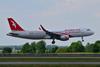
The incident, which took place on 4 May, involved an Airbus A320 (registered A6-AOS) operated by Air Arabia, as well as a Boeing 777 freighter (registered D-AALJ) operated by AeroLogic.

Both aircraft were flying from the Muscat flight information region into Mumbai’s flight information region when the incident occurred, according to the final incident report issued by India’s Aircraft Accident Investigation Bureau (AAIB).
The Air Arabia A320 was ahead of the AeroLogic freighter with both scheduled to operate on the same flight path but at different flight levels at waypoint PARAR, which straddles both Muscat and Mumbai flight information regions.
The Air Arabia aircraft was to have climbed slightly from 35,000ft to 37,000ft at the waypoint, while the 777F was to remain at 35,000ft.
“However, both crossed PARAR and entered Mumbai flight information region at the same flight level, with a three-minute interval. The [AeroLogic 777F] maintained a higher ground speed, approximately 40kts faster than [the Air Arabia A320], reducing separation,” the report states.
The AeroLogic aircraft was subsequently issued vectors to offset its lateral position – descending to 31,000ft – to ensure a safe separation, and both aircraft landed at Mumbai without incident.
The Air Arabia A320 was carrying 166 passengers and crew, while the AeroLogic freighter had two crew members on board.
The AAIB found that the closure of Pakistan airspace during the period – a result of escalating tensions between India and Pakistan – had led to “increased traffic density” in the area, which in turn increased the workload of controllers.
It noted that the air traffic controllers at Muscat’s flight information region “missed” commanding the Air Arabia jet to climb to the higher flight level due to “increased workload”.
This was because the controller was also “imparting on-job training” to a trainee, amid “complexity” in traffic conditions due to the Pakistan airspace closure.
Meanwhile, Mumbai controllers were found to have a “delayed response” in monitoring – and resolving – the airprox incident.
This was because the accepting controller was “engaged in handling estimate coordination over the hotline in the absence of a dedicated coordinator”, the AAIB found.
To this end, the bureau recommends that all ATC positions “should be adequately manned” to ensure that controllers can focus on their tasks “without distraction”. At the same time, it recommends that instructors not be assigned dual roles during on-the-job training.
According to data by aviation analytics firm Cirium, the Air Arabia A320 was delivered to the low-cost operator in 2017, while the AeroLogic 777F was manufactured in 2009 and was first delivered to LATAM Cargo before being handed over to the German cargo carrier in 2017.