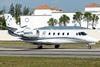












US investigators have revealed that a bent elevator pushrod was discovered on a Cessna Citation 560XL following a serious incident in which it entered an uncommanded steep climb and a series of pitch-up excursions to the point of stalling.
The aircraft entered an unusually high nose-up attitude immediately after landing-gear retraction as it departed Fort Lauderdale’s executive airport on 14 August last year.
Its pilot was unable to lower the nose and handed control to the other pilot, who put full forward pressure on the control column.
Both pilots were unable to arrest the climb, and the jet reached 9,500ft – far above its assigned altitude of 2,000ft.
The crew had carried out a left turn in a bid to return to the airport but they were unable to see the runway owing to the steep attitude.
Nor could the pilots switch to the Miami en route centre frequency because both were pressing on their control columns in an effort to prevent a stall, says the US National Transportation Safety Board.
“Over the next several minutes, the crew attempted to maintain control of the airplane during a series of radical pitch-up events into one or more stalls, followed by an uncommanded steep pitch-down event,” it adds.

The aircraft proceeded towards Fort Lauderdale’s Hollywood airport – located about 7nm south of the executive airport – and the pilot performed an orbit, with idle thrust and speedbrakes deployed, to shed airspeed.
But the aircraft remained about 30kt above normal approach speed as it descended for runway 10L. As the jet neared touchdown, it entered ground effect, and pitched up again.
The pilot corrected the attitude and landed on the final quarter of the 9,000ft runway before bringing the aircraft to a halt.
Neither of the pilots was injured but the safety board says the jet (N802TD) was “substantially damaged”.
Examination of the aircraft showed that an elevator pushrod was “bent, with evidence of contact with an adjacent structural member”, it adds. The pushrod is part of the linkage between the flight controls and the elevator surface.
The aircraft had been at the executive airport to be painted.
Prior to departure one of the pilots conducted an external check, arranged a fuel uplift, and performed a number of checks with personnel from the paint shop – including engine runs, flap cycling, and flight-control positioning.
“During this time, the pilot noticed that the control column seemed a bit closer than he remembered when it was full forward as compared to a different airplane of the same make and model,” says the safety board.
“Otherwise, the controls seemed to move as normal with no unusual binding or limitations.”
Investigators have yet to reach formal conclusions about the cause of the occurrence.