











Boeing in 2011 told airlines to watch for potential failures of a pylon bearing assembly now central to the National Transportation Safety Board’s (NTSB) investigation into the 4 November crash of a UPS Boeing MD-11 Freighter.
In that service bulletin, Boeing recommended that MD-11F operators inspect “spherical bearing assemblies” but did not require they replace the parts, according to a 14 January NTSB investigation update.
“According to the service letter, a review of the spherical bearing failure by Boeing determined it would not result in a safety of flight condition,” says NTSB.
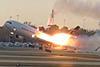
The UPS MD-11F (registration N259UP) crashed shortly after taking off from Louisville Muhammad Ali International airport’s runway 17R, killing all three pilots and 11 people on the ground.
Moments after getting airborne, its left GE Aerospace CF6 turbofan and left pylon separated from the wing, sparking a fire.
The NTSB has since early on focused its investigation on a failed aft mount assembly in the MD-11F’s left engine pylon. That assembly, which connects the pylon to the underside of the wing, consists of a bearing assembly housed within two lugs. The bearing assembly itself has an outer race housing an inner “ball element”.

Investigations found evidence of fatigue cracking in one of the two lugs, and along the interior of the bearing race, which fractured into two pieces. Notably, the fatigue cracks in the race originated at the edge of a recessed groove.
“The fatigue cracking extended through the thickness of the bearing race toward the exterior surface, encompassing about 75% of the fracture surface, with the remaining fracture surface consistent with overstress failure,” the agency says.

Boeing’s 2011 service bulletin informed “operators of four previously reported bearing race failures (on three different airplanes)”, the NTSB says. Those failures also started at the recessed groove and involved races splitting into two pieces.
Boeing’s service letter notes that, normally, the sides of the race should lie flush with the outer surfaces of the lugs. It says the known failures involved race pieces sticking out beyond the surface of the lugs.
The letter told operators to check the bearings during visual inspections of pylon aft mounts, typically completed every 60 months. It notes Boeing updated its MD-11 service manual to include checking that races are not “protruding forward or aft” of lug surfaces.
Additionally, the letter recommends airlines replace unserviceable bearings with a different modified bearing but does not prohibit carriers from replacing unserviceable bearings with bearings of the original design.
The NTSB is still working to understand how UPS incorporated into its MD-11 maintenance programme the information contained in Boeing’s service bulletin, it says.
Asked to comment, UPS says, “The NTSB controls the flow of information developed in the investigation. As UPS continues to cooperate fully as a party to the investigation, we are unable to comment on any aspect of it.”
“We remain profoundly saddened by the flight 2976 accident. Our thoughts continue to be with the families and Louisville community who are grieving, and we remain focused on the recovery effort,” UPS adds.
Boeing does not respond to a request for comment.