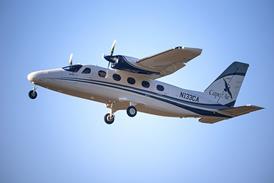







Expectation bias played a role in a Raytheon Hawker 850XP crew’s decision to take off without clearance from Houston, before the jet collided at an intersection with a landing Textron Aviation Citation Mustang.
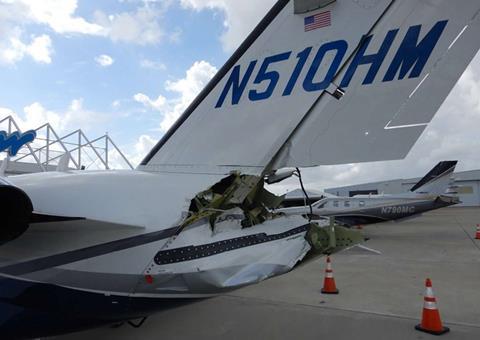
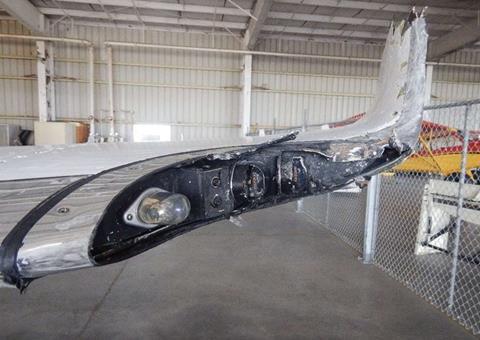
As the Hawker neared lift-off from runway 22 at William Hobby airport, its left wing-tip struck the tail cone of the Mustang which was rolling out on runway 13R.
The Hawker crew continued the take-off and, during the initial climb, advised air traffic control that they needed to return to the airport.
It subsequently landed safely. Neither of its two pilots nor its passenger were injured during the 24 October 2023 accident. Although the Mustang had its tail-cone sheared off by the impact, there were similarly no injuries among the pilot and three passengers.
Some 30s after the inbound Mustang crew reported being on 4nm final – having already been cleared to land on 13R – the Hawker crew was instructed to line up and wait on runway 22.
Although the local air traffic controller “did not provide a [required] traffic advisory to either airplane regarding the other”, says the National Transportation Safety Board, this probably had no influence on subsequent events because the Hawker crew read back the line-up clearance.
Despite the correct readback, both pilots testified to investigators that they recalled hearing a take-off clearance.
The inquiry says air traffic control recordings revealed “no take-off clearance” was issued to the Hawker, or any other aircraft, at the time – and attributes the discrepancy as being “likely due to the pilots’ expectation bias”.
Investigators believe distraction also contributed to the misunderstanding. Around the time of the line-up clearance, the Hawker crew realised that V-speed references were not displayed on their instruments, and one of the pilots started re-entering data into the flight-management system.
This hold-up, combined with the perception that the aircraft had been cleared for take-off, put pressure on the crew not to delay and may have “exacerbated their expectation bias”, the inquiry says. The crew discussed the issue with the speeds and elected to proceed with the take-off.
When the Hawker began rolling without take-off clearance, the airport’s ASDE-X surface-movement system alerted the tower to a potential collision.
But although the controller twice instructed the Hawker crew to stop and hold position, there was no response.
The inquiry says that, as the aircraft began moving, the pilots had to deal with a rudder-bias system activation and an elevator trim warning.
“These activities likely distracted the pilots and prevented them from recognising the instructions from the [controller] to stop,” it adds.
Runway 22 intersects with runway 13R some 4,500ft from the 22 threshold. Visibility was good at the time, but the pilots did not see the Mustang – rolling out from its landing – until about 1s before the collision.
The inquiry says the cockpit-voice recorder had been inoperative before the flight, despite the crew’s having opportunities to test its functioning, and no relevant information could be obtained from it.
Operated by DuPage Aerospace, the Hawker sustained wing-tip and winglet damage, including a dent to the leading edge, and an impact-separated navigation light lens.