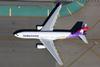















Hawaiian Airlines has a five-year plan to invest $600 million on modernising airports in Hawaii and refreshing the cabins of its Airbus A330 widebody jets.
Revealed on 5 January, the so-called Kahuewai Hawaii Investment Plan calls for sustained investment in Hawaiian’s physical and digital infrastructure, particularly in airports in Hawaii.
The Honolulu-based member carrier of Alaska Air Group plans to begin upgrading customer-facing technology –and the lobbies and gates at airports in Honolulu, Lihue, Kahului, Kona and Hilo – starting this year and continuing through decade-end.
Meanwhile, it will start overhauling its full fleet of A330s in 2028. New furnishings will include seats, carpets, lighting, first-class suites and a premium economy cabin.
Hawaiian says it is ”acquiring three of its A330 aircraft off lease to support the future of this fleet in its service across the Pacific”.
Fleets data provided by aviation analytics firm Cirium show that Hawaiian currently operates 33 A330-200s and -300s.

In addition to the newly announced investment plan, Alaska Air Group said last month it is investing in Hawaii-produced sustainable aviation fuel (SAF) through partnerships with energy producer Par Hawaii and Pono Pacific.
The airline does not disclose financial details of those investments.
”Pono Pacific’s crop trials drew the attention of Alaska Star Ventures, the venture capital arm of Alaska Air Group that invests in technologies to drive aviation efficiency, performance and innovation,” the airline group says.
Alaska Airlines and Hawaiian plan to become the launch customers for Par Hawaii’s locally produced SAF in the first quarter. Meanwhile the companies are studying the use of camelina sativa – a flowering plant that grows both agriculturally and naturally in Hawaii’s tropical climate – as feedstock for the development of future SAF products.
Pono Pacific says it is launching a subsidiary called Pono Energy to accelerate development of camelina as a source of feedstock.
The company says that camelina is a ”high-yield, pest-resistant cover crop that can be grown in rotation with food crops, reaching maturity in just eight to nine weeks. Its oil seeds can be crushed to produce renewable fuels, including SAF, while the remaining seedcake can be turned into government-approved, nutrient-rich feed for cattle and chickens”.
Using farmland to produce SAF for airline operations is controversial, as some studies have highlighted land-use issues such as reducing space available for food production.
On another sustainable aviation front, Hawaiian says it is investing in hybrid-electric propulsion start-up Ampaire to explore lower-emissions short-haul flights, potentially for island-hopping operations.