












US electric aircraft development Beta Technologies is pursuing an initial public offering on the New York Stock Exchange, seeking to raise money to fund continued development of its Alia family of small aircraft.
Vermont-based Beta on 29 September filed a new-securities registration form with the US Securities and Exchange Commission, signalling its intention to issue publicly traded stock.
Beta declines to comment about its plan or timeline, saying it is “currently in a restricted communications period”.
IPOs can often take one year or longer to be completed.
Included with the filings is a broad review of Beta’s business that includes financial figures.
The firm lost $158 million in the first half of 2025, reflecting minimal revenue and $116 million in research and development expenses.
Beta ended June with cash and cash equivalents valued at $175 million.
The company lost $276 million in 2024 and $176 million in 2023, the securities filing shows.
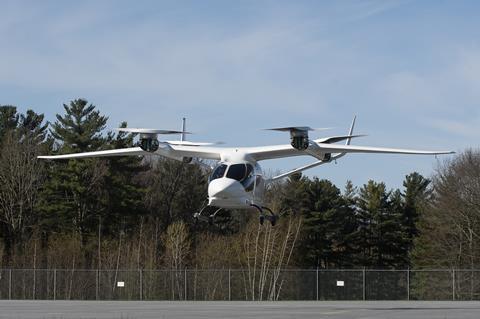
Beta is developing two variants of its Alia all-electric single-pilot aircraft.
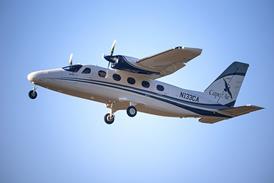
The CX300, the model Beta is pursuing first, is a conventional take-off and landing (CTOL) aircraft, with wings that provide lift and an aft-mounted propeller providing forward thrust. It will fly at 135kt (250km/h) and be capable of carrying five passengers over distances up to about 116nm (215km), Beta says.
Its Alia A250 is to be a electric vertical take-off and landing (eVTOL) variant. Beta does not specify that model’s range.
The company has longer-term plans to bring a 19-passenger aircraft to market – a concept that will create “new opportunities for operators to realise the benefits of electric aviation in large aircraft”, securities filings show.
The documents make clear Beta expects to generate revenue not only from selling aircraft but also from selling replacement batteries and ground-support equipment.
Beta anticipates “typical” electric aircraft will require new batteries roughly once every year.
Additionally, Beta plans to sell propulsion systems to other electric aircraft manufacturers, specifically including Textron’s eAviation division, the filing says. That unit includes Slovenian electric aircraft developer Pipistrel.
“Vertical integration allows us to innovate rapidly and capture meaningful economic value throughout an aircraft’s lifetime by providing batteries and aftermarket services for Beta aircraft and other customers,“ Beta writes. “Our focus is on the enabling technologies essential to electric aviation, including batteries, motors, flight-control systems and a nationwide network of electric charging and related equipment.”
The company initially intends to sell its aircraft to operators specialising in carrying cargo and performing logistics, medical and military operations. It envisions eventually producing passenger variants.
The company estimates demand exists for some 60,000 aircraft in its market segment, worth $250 billion.
Beta says its aircraft will cost 42% less to operate than conventional types due largely to less maintenance expense.
The company has for years been flight testing its all-electric CTOL demonstrator and has recently moved to real-world operational testing in conjunction with Bristow Norway.
Founded by chief executive Kyle Clark, Beta had previously primarily pursued developing an eVTOL, but in 2023 shifted to prioritise the CTOL design, citing a “de-risked… path to certification”.
Beta says it’s Alia demonstrator has completed “thousands of flights” covering some 83,000nm over North America and Europe.
The company this month said it partnered with GE Aerospace, which became an investor. Embraer-owned Eve Air Mobility, a Beta competitor, said in August that it plans to test its aircraft with Beta’s motors.
With the traditional IPO plan, Beta is pursuing a path different from other electric-aircraft developers that in recent years went public by merging with so-called Special Purpose Acquisition Companies (SPACs).
The method, which involves existing public companies merging with start-ups, was wildly popular amid low-interest rates and easy capital several years ago. It has since fallen out of favour, soured by regulatory scrutiny and some SPAC darlings failing to meet expectations.
Beta competitors Joby Aviation, Archer Aviation and Eve are among firms that went public several years ago by merging with SPACs.