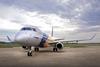












Heightened trade tensions between the USA and Brazil are emerging as a potential threat to Embraer’s commercial aircraft sales, though details are scarce and it is unclear how the Brazilian airframer stands to be affected by US President Donald Trump’s latest tariff salvo.
After several weeks of relative quiet on the trade war front, Trump is again rattling global markets with threats to ratchet up tariffs on trade partners – including a threat to impose duties as high as 50% for products imported from Brazil.
That is a significant jump from the 10% “baseline” tariff Trump has unilaterally imposed on most of the world’s countries, which Brazilian companies have priced into their financial plans.
Brazilian president Luiz Inacio Lula da Silva stated in a TV interview that, while he would prefer a diplomatic resolution to Trump’s threat to hike tariffs on 1 August, Brazil would impose a reciprocal 50% tariff on imported US goods if provoked.
Unless an exemption is carved out for Brazilian aerospace products, driving tariffs up to 50% would likely increase the price of regional jets for US customers. Whether those costs could be passed on to airlines remains an open question.

Embraer tells FlightGlobal on 10 July that it is “assessing the potential impacts on its operations following the US government’s announcement yesterday regarding a possible increase in tariffs on Brazilian products”.
“The company is evaluating whether the new measure will specifically impact the Brazilian aviation industry,” it says.
Any anticipated hit to Embraer’s bottom line will be reported during the company’s second-quarter earnings call on 5 August. The airframer says it is ”actively engaging with the relevant authorities seeking to restore the zero import tax for the aeronautical sector”.
With US sales of Embraer’s E2 series of larger narrowbody jets not as strong as hoped – due in part to a scope clause that prevents US pilots from operating that size aircraft, particularly the E195-E2 – the recent revival of interest in the first-generation E175 has been key to the company’s continued success in North America.
At the end of the first quarter – Embraer has yet to release its latest figures – almost 95% of its 160-unit firm order backlog for the E175 was from US carriers, including American Airlines (90), Republic Airways (40), Skywest Airlines (16) and Horizon Air (five).
That percentage will only have increased too, as SkyWest placed a firm order for 60 E175s, plus purchase rights on an additional 50 aircraft, during last month’s Paris air show. The Utah-based carrier already operates more than 260 of the jets.
Asked to comment on the developing situation, SkyWest says that ”much can change and it is too early to say”.
”SkyWest continues to evaluate the macroeconomic environment and will adjust accordingly,” it says.
American, which ordered the E175s for operation by its regional subsidiary Envoy Air, declines to respond to FlightGlobal’s request for comment.
Should the higher tariffs come into force, airlines will be left with few options, none of them particularly palatable given the complete lack of alternatives to the E175 on the market, US-built or otherwise.
US operators have already had to absorb the 10% increase on Embraer jets from the initial baseline tariff, which has likely been passed on to customers through increased ticket prices.