











Last year’s amicable divorce between NBAA and European counterpart EBAA saw the annual convention the two trade bodies had run jointly since 2001 take a very different complexion.
May’s slimmed-down EBACE in Geneva had no aircraft display and – apart from helicopter manufacturer Leonardo – zero OEM involvement.

After pledging to reinvent the annual show following this “transition” year – including in possibly a new location – EBAA in August made a surprising announcement: EBACE would be returning to the Swiss city in 2026, and every subsequent even year.
In between, it will take place in other, so-far-unannounced European municipalities.The move appears to be a compromise between those who want the event to remain in Geneva, its home for almost a quarter of a century, and those who would like it to shift to another city – or rotate among several – taking it closer to its members across Europe.
With almost as many opinions about where EBACE should take place as EBAA members, consensus was next to impossible. Unlike a private events company where management are tasked with creating shareholder value, EBAA strategic decisions – including over EBACE’s future – are ultimately made by a 13-member board.
Some of this tension was likely to have been behind the decision by secretary general Holger Krahmer to step down from his role with immediate effect on 27 June, days before an announcement about EBACE 2026 was due. He was replaced on an interim basis by Stefan Benz.
Like NBAA-BACE’s new long-term location, Las Vegas, Geneva has much to offer. With superb air and ground transport connections, the charming and compact city is convenient to get to and around. The Palexpo is also one of the few exhibition complexes in Europe next to a major airport, allowing for an on-site static display.
Geneva also has a cachet. With its opulent lakeside hotels, high-end restaurants, international banks, and luxury shops it attracts many of the ultra-high-net-worth individuals who own or fly on private aircraft.
However, that is also its downside. The city can be eye-wateringly expensive, especially for non-members of the caviar and champagne international jet set, including EBACE delegates and exhibitors, who must shell out on pricey accommodation and dinner bills.
That was not so much of a problem when prospective buyers were attending EBACE in force, compelling all the manufacturers to be there and creating a halo effect that lured suppliers, charter operators, and service providers to Geneva for the week.
However, many noticed that demographic tailing off in the years before and after the pandemic, something that impacted the value proposition for OEMs. Recent editions have seen a marked decline in the number of glamorous customer parties.

EBACE began modestly in 2001, taking up part of Hall 7 and attracting 3,500 visitors. But an explosion of interest in business aviation outside its traditional North American core market saw the event grow rapidly.
By the turn of the decade, despite the global financial crash, attendee numbers had risen to around 13,000. The 2010s were the heyday of the show with almost every year seeing a big aircraft unveil: the Cessna Citation Longitude in 2012, the Pilatus PC-24 in 2013, the Dassault Falcon 8X in 2014, and Bombardier’s Rolls-Royce Pearl 15-powered Global 5500 and Global 6500 pairing in 2018.
Although as recently as 2017 there were more than 60 aircraft on display, there were signs the show might have peaked. Covid dealt another blow with EBACE struggling to bounce back from a two-year hiatus (NBAA-BACE, by contrast, returned to Las Vegas in October 2021 after missing just one edition).
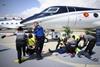
An incident in 2023 when dozens of environmental protestors broke through the airport fence and chained themselves to jets on the static display inflicted further reputational damage on the show itself and that of the Swiss authorities’ ability to provide adequate security.
With a lull in aircraft launches likely to last the rest of this decade, and some OEMs opting to host their own customer events rather than support big industry shows, whether there is room for two programme-focused business aviation conventions each year is up for debate.
But many would argue that the world’s second biggest business aviation market deserves its own event. EBAA is spending these months looking at how it can best meet that need in 2026 and beyond.