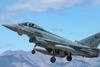












UK airframer BAE Systems remains confident that Saudi Arabia will place a long-anticipated follow-on order for the Eurofighter Typhoon, as Riyadh also eyes a possible future role in the currently three-nation Global Combat Air Programme (GCAP).
The Royal Saudi Air Force (RSAF) currently operates 72 BAE-assembled Typhoons, fielded from 2008 via the Project Salam acquisition.
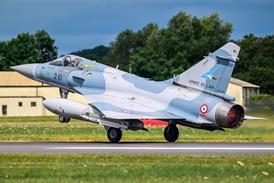
The European type also is being considered for a 54-aircraft need, which also has seen Riyadh look at the Boeing F-15EX and Dassault Aviation Rafale as part of a competitive evaluation.

“We are still supporting the UK government in responding to the requirement for new Typhoons,” BAE’s Saudi Arabia managing director Steve Clutton said at the World Defense Show (WDS). “Discussions are ongoing, and it has been a great opportunity at the show this week,” he says of the 8-12 February event, which was staged near Riyadh.
A repeat Typhoon order would be linked to a “substantial industrialisation package”, he says. That would include in-country final assembly of the type, in support of the customer’s Vision 2030 localisation process.
Under a previous deal, 22 of the RSAF’s BAE Hawk 165 advanced jet trainers were assembled at the service’s Dhahran air base. Clutton also notes that more than 100 aircraft parts are already manufactured locally as part of the airframer’s equipment support package, and that increasing such activities “is a big part of our offer”.
BAE will later this year mark 60 years of activity in the kingdom, with that relationship having been initiated through RSAF orders for English Electric Lightnings and BAC Strikemasters.
Notably, the UK’s recent signature of a full production deal to equip 40 of the Royal Air Force’s (RAF’s) Tranche 3-standard Typhoons with the Leonardo ECRS Mk2 active electronically scanned array radar means that the equipment can now be formally included in an offer to Riyadh. The advanced sensor will provide improved detection performance, but also introduce an electronic attack capability onto equipped jets.
While it has been pursuing a repeat order for several years, a new contract to provide additional aircraft to Saudi Arabia would provide a welcome boost to BAE, which late last year also clinched an order to supply the Turkish air force with 20 Typhoons. Those fighters will be assembled at its Warton site in Lancashire, northwest England.
Intriguingly, Boeing executives also speaking at the WDS event indicated that while Riyadh had sought information from other manufacturers for the 54-aircraft requirement, this has not yet been followed by a formal request for proposals.
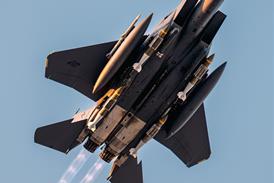
Indeed, Boeing’s in-country president Asaad AlJomoai referred to a possible upgrade for the RSAF’s in-service F-15SA/SR fleet as “the viable option” likely open to the US airframer, versus a sale of new-build EX-model examples.
And although US President Donald Trump last November suggested that Saudi Arabia could potentially receive approval to acquire Lockheed Martin F-35 fighters, Clutton does not feel that any future order will derail a Typhoon deal.
“If you look at the RAF, with Typhoon, F-35 and GCAP, it’s a very complementary mix,” he notes.
The RSAF’s current fast jet recapitalisation need focuses on acquiring replacements for its remaining Panavia Tornados – the veteran type is likely to leave use around 2030 – and also its oldest F-15s: C/D-model examples which are up to 45 years in age.

Looking beyond the Eurofighter’s capabilities to a sixth-generation platform, Clutton states: “When you speak to our Saudi colleagues, their aspiration is they would love to be a partner in GCAP.
“They appreciate everything that the UK has done on our current programmes, and they trust us to deliver,” he adds.
However, that process remains the subject of government-to-government and quadrilateral discussions involving the UK and its GCAP partners Italy and Japan.
Meanwhile, Herman Claesen, BAE’s managing director future combat air systems, tells FlightGlobal that the GCAP activity remains on track, despite the delay to a key contractual milestone being caused by London.
The programme had been due to progress into its next phase with an approval at the end of last year, but this has yet to occur due to the UK running late with completing its defence investment plan process.
“The work continues – there is no slowdown – and we continue to march on,” says Claesen, who is also chairman of the Edgewing industrial venture tasked with delivering GCAP.
BAE also is separately advancing its own combat air fighter demonstrator, which will produce the first all-British supersonic design since the Eurofighter-precursor EAP of the mid- to late-1980s.
“It is taking shape physically,” he says. “One wing is now in structural test, and we are gathering all the [design performance] evidence.”
While the Eurojet EJ200-powered aircraft will not be ready to fly before the end of 2027, Claesen notes: “The value that is coming out of this programme is extraordinary – we are learning lessons for GCAP.”